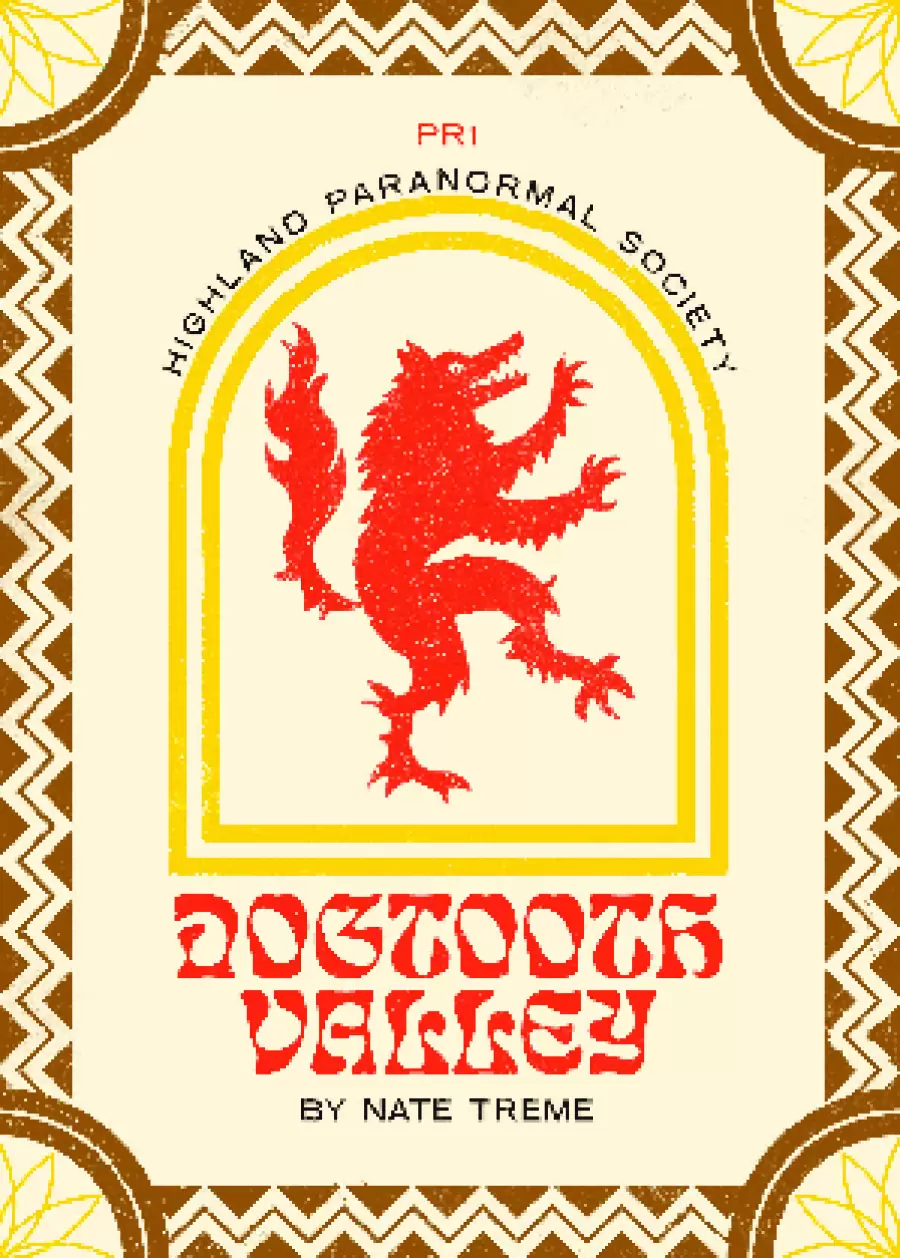
By Nate Treme
Highland Paranormal Society
OSR
Levels 1-2
The valley is a remote region in the shadows of the Dogtooth mountains—colloquially ‘the Dogteeth.’ While the Dogtooth Outpost is a relatively new settlement, some older civilizations’ ruins are scattered about the region. The Outpost is intended as a starting point players venture out from. Perhaps they are locals, passing travelers, or recent arrivals seeking work. They could have been sent to investigate the graverobbing or put a stop to the Coyote banditry.
This 24 page digest adventure describes six hexes, most with a six room dungeon in them. It;s cutesy and devoid of anything that could resemble a well put together modern dungeon.
Them’s fighting words! Indeed. We’re going to an Italian restaurant! Uh. Ok. Like, a pasta one or a seafood one or a meat one or like something else? We’re going camping! Uh, ilke, in a 53 foot long Rv parked in the middle of football field two feet away from another one or are we backpacking in a day and a half and then a day and a half back, uphill both ways? (Thanks, new Hampshire!) It’s a D&D adventure! Ok, uh, like, Mork Borg or Harn or …? There is absolutely nothing in the marketing of this adventure that would indicate its, shall we say, fanciful nature. In fact, I would suggest that the marketing page for it on DriveThru seems to indicate it’s a more realistic version of a D&D world, Harn or C&C or maybe even Greyhawk. The System is just ‘OSR’, so no hint there of anything amiss.
I got two complaints. Well, I got a lot of complaints but two central ones. The first, as I’m alluding to, is that this is kind of a bait and switch marketing. On purpose? Meh, maybe not. But, the adventure has this on the wandering monster table “Bakery drawn by a giant beetle. An old woman sells muffins and scones. Guarded by 3 orangutans.” And it’s VERY turtle forward. Or tortoise. Whatever; same thing in the soup pot. 20% of the wandering monster table is turtle related. The inn in town is the Tipsy Turtle. There’s a giant zombie tortoise in a dungeon. Theres more. The town has a couple of farms, a tavern, a general store and a post office. Hmmm. That’s interesting. A post office. Taking these together, the turtles, the post office, the mobile beatle barley with orangs, this tells us something about the game world. And I think we all know that this is not C&C or Harn. This is one of those indie OSR game worlds where anything goes. And that’s ok. Except, the marketing doesn’t tell us that’s what I’m about to pay twelve dollars for. Showing me a photo of a $12 hamburger and then serving me a bowl of 12 soup is likely not going to go over well.I’m going to assume this is not a bait & switch and it’s just a mistake. If you’re adventure is set in 6th century rome and you then you probably need to disclose that, If you need a space faring D&D ship for the adventure then you should probably disclose that. You’ve got to give a potential customer SOME idea of what they are about to buy. You can’t put a hello kitty (mother fucker! I wanted that Batz rodan figure!) DVD is a poirot box and sell it and not expect complaints.
This is not my preferred setting. It’s ok if you like it, of course, but I know that’s not really what I’m looking for in an adventuring world, just as I avoid story games and 4e adventures. But that don’t mean that you don’t deserve a good adventure. And this ain’t that.
The core of this is going to be the five one page dungeons, with about six rooms in each dungeon. IE: what can fit on a page. The first dungeon has a solid hook in town; three graves have been dug up and a paint trail leads away. Why paint? Why, because the necromancer is a painter of course. Anyway, after that first thing the other hexes have some vague rumors in town but nothing really linking them to anything going on. It is aimless
And then the dungeon descriptions. “Ash Urns. Three large ash-packed urns.” or “Magma melted through the North wall. 1d6 stone ogres lounge in the magma pool.” or “Workshop. A massive anvil, a hammer, calipers and an iron boar-faced shield.” So we’re talking about very minimal room descriptions. There’s an overall, blandness? Aimlessness? Going on. For while it attempts to pump things up with some wacky rooms things, like a “is it cake?” room, or the bad painter necromancer, or the mobile beatle/orang bakery, it’s not really doing anything besides providing that basic wackiness. So, solve a beard length puzzle to lower a bridge, or Is It Cake trap, or a room that does 1d6 damage every turn with an obvious magic item in it. Conceptually it;s ok. But the room descriptions are a little lacking for single/two sentence entries. And with very little to tie them together, or to care about, combined with the small size of the dungeons, it just feels off. There’s no feeling of tension in the adventure. No one really seems to care about anything. Yeah, you can fall in to lava, or need to lower a bridge, but even then the room doesn’t FEEL dangerous. The whole thing just feels BLEH.
Combine this with an emphasis on the room, singular, not tied in to the larger dungeon or setting. A room tells us “A band of three skeletons play a sloppy waltz on drum, guitar and trumpet.” It’s as if this rooms exists in isolation, the sound anyway. Sure. there’s a necromancer and they are quirky. But, the sound carrying in to the next room, or rooms away, builds tension and thats something that the designer should be leaning in to , helping the DM do the same for the impact on the party/players.
It’s a cutesy setting and it lacks the tension, the feeling of risk, that needs to be present to make the game come alive. It’s in it for the lolz.
This is $12 at DriveThru. The preview is four pages. There is one page of relevant text, the last one, which shows the wandering monster table. From that you’re going to have to determine the idiosyncratic setting. It needed to, perhaps, show an entire dungeons encounters.
https://www.drivethrurpg.com/en/product/586786/dogtooth-valley?1892600