Hex Crawls

Re: the hex coordinates thing

I personally find the XX:YY thing a bit suboptimal because in the moment with a million other things to do, remembering which is vertical and which is horizontal is just another burden. Instead, whenever I'm hand-keying a hex map, I use numbers for one axis and letters for the other. It makes recognising the specific coordinates just that little bit quicker and easier. Unfortunately, Hexographer doesn't do this automatically.

More generally, EOTB and I work similarly when it comes to generating hex crawls. I'll randomly generate a hex map, tune the geographic layout, randomly generate the contents using a couple of random tables (usually an encounter grid and a small table that resembles the empty/monster/traps/treasure table from AD&D 1e but with lairs, settlements, etc.), then do a fine pass to create structure and add in specific hand-crafted points of interest atop that.
 
More generally, EOTB and I work similarly when it comes to generating hex crawls. I'll randomly generate a hex map, tune the geographic layout, randomly generate the contents using a couple of random tables (usually an encounter grid and a small table that resembles the empty/monster/traps/treasure table from AD&D 1e but with lairs, settlements, etc.), then do a fine pass to create structure and add in specific hand-crafted points of interest atop that.
How often do you find yourself doing this? Just curious how often y'all generate a campaign world for play?
 
How often do you find yourself doing this? Just curious how often y'all generate a campaign world for play?

If you count any sort of step beyond ideation as generation, I'd say I've created over 25. If you mean up to the level where it could at least be used to launch a campaign, I'd say about 12. It's something I like doing, and I tend to run shorter campaigns. At this point, I have three I consider "live":

1) The Dawnlands - A Mythras/Openquest setting I've been working on aspects of since 2008 and that I've run multiple short campaigns in. Sort of a psychedelic mythic fantasy setting inspired by fiction about Central Asia (Dictionary of the Khazars, Gentlemen of the Road, etc.)

2) Verra - A setting I started working on in 2019 as a Pathfinder 2e setting for a game I thought would launch in early 2020. The game has been delayed to launch in early 2022, hopefully, but I've been working on it off and on throughout COVID. It's a high magic 17th century not-Corsica.

3) Necrocarcerus - Previously a heavily house-ruled Swords and Wizardry Complete, I'm shifting it over to my own Into the Depths system for the next iteration. I've run multiple campaigns in this, the longest being a weekly campaign that lasted around two years and change. It's a post-apocalyptic parody of capitalism and Dungeons and Dragons set in the afterlife. The weirdest but also the most accessible of any of the settings to pick up and go.

These are settings where I am "ready to go" if someone asked me to run a campaign for them and gave me about a week to do some planning.

The more you do world-building and campaign set-up, the faster it gets each time. You also learn how to be judicious about setting the scope of initial work you need done (the "minimal viable product" if you will) and then how to set a scope of work for future expansions of the setting. I know what I need to go with, and I know what I'll need to come up with to continue going on.

I also find that I'll recycle good ideas between campaign settings, especially if I didn't get a chance to use them in a previous campaign. Verra, for example, is a rework of some material and ideas from two previous campaign settings, one that I ran using Mongoose Runequest II in 2009, and an Openquest campaign setting from late 2015 that I created half as an exercise to get a grip on Hexographer's utilities and on Openquest as a system. I would have run a campaign with the latter, but the computer I had everything saved on died in early 2016 just as I was about to start soliciting players online.
 
The "algorithms" only give you the chaos to sculpt.

That sums it up succinctly. Like EOTB said, without the randomness of the dice, the worry is the world is going to look intelligently designed and thus predictable. The dice also throw new kinks into what might be otherwise fairly linear adventure/location ideas.
 
3) Necrocarcerus - Previously a heavily house-ruled Swords and Wizardry Complete, I'm shifting it over to my own Into the Depths system for the next iteration. I've run multiple campaigns in this, the longest being a weekly campaign that lasted around two years and change. It's a post-apocalyptic parody of capitalism and Dungeons and Dragons set in the afterlife. The weirdest but also the most accessible of any of the settings to pick up and go.

Tell me more...
 
EOTB hits it out of the park again.


God damn this good! Could I trouble you for an example clarifying that last sentence?


I'm guessing you despise looters like Diablo and Torchlight. Rogue-style games. I hate gambling for money as well, but I can let myself go with these games. Drinking a beer and mindlessly grinding mobs for a legendary drop long after I have finished the central plot is somehow relaxing.

So we've first of all established, like all the other play systems in D&D, wilderness exploration has a variety of styles, which is as Squeen mentioned, muddying the conversation. There's people who only have a hex map on the DM's side, leaving the players to discern a freeform, organic world. Others enjoy clearing the fog of war, hex-by-hex as in X1. Some use a node structure to set up a Point or Path Crawl. There's more, but that's what I've got off the top of my head. Each has its benefits and drawbacks that make them appealing to some but not other DM's and players.

My players have had their best nights when they've run off my reservation and I've been forced to improvise, frequently cribbing off a list of short, procedurally generated seeds. Presenting a blank hex map with maybe some visible boundaries (like shores or mountain ranges) creates a diverting mini-game, allowing players to point at things and say "I want to go there. I want to see what that is." This can be a LOT of fun. Maybe your players hate that. Know your audience. Know yourself. If you're uncomfortable improvising, stick to a structured style of play like a Point Crawl, for sure!


Jesus christ noob. you complete me. I'm telling my wife tonight. :ROFLMAO:

@The1True & @squeen thanks! It was off the dome. Working title is? Geometry or Shapeless, Questions of Life: A Contextual Reanalysis of Postmodern Despair and Culture at Large
 
Last edited:
For my prep process I have to get off the blank page as quickly as possible. My secret sauce doesn't start flowing until I have something to work with. So I randomly generate everything and then start working with the chaos, as you put it. I don't know if you're familiar with Matt Finch's Tome of Adventure Design, but his essay on the Jabberwocky poem also fits this stage of hex crawl design also, IMO.
Having done a number of hexcrawls, the pattern I am finding is that I have anywhere from a dozen or two dozen specific ideas to populate a map with. A letter sized hexcrawl formatted maps will generally have 100+ entries. Over the years I assembled a bunch of random tables to populate the rest of the map.

Crucial to the process I use is that I don't do just one pass. Instead I review the random items generated and start fleshing out anything that inspire me. Then I look at the surrounding entries and if they work, I keep the result. If they don't then then I roll again until I find something that makes go "yeah".

The root problem is the volume of entries that can be handled by the hexcrawl format. Sure the travelogue format used by the World of Greyhawk and Forgotten Realms can be expansive however the author can "cheat" by covering vast regions with but a paragraph. With the hexcrawl format focus on local level details you can't really do that without the result being jarring. "What the heck is this big space with nothing it?"
 
Right. If the players say they want to stay and explore the 1/3/5/6/12 mile region, there should be something for them to find. There's a feedback loop to that: once the players figure out there's rewards (even if the reward is just the discovery of an interesting chunk of landscape or mundane artifact) to stopping and smelling the roses, they will do it more often, which will in turn reward your bothering to fill in the blanks ahead of time.
 
My view is that nothing exists in a vacuum. Whatever exists in an expanse of the unknown (to the players) will ripple out beyond the borders into what known. To me the boundary is not a hard line but a fuzzy area bleeding in and out in both directions.

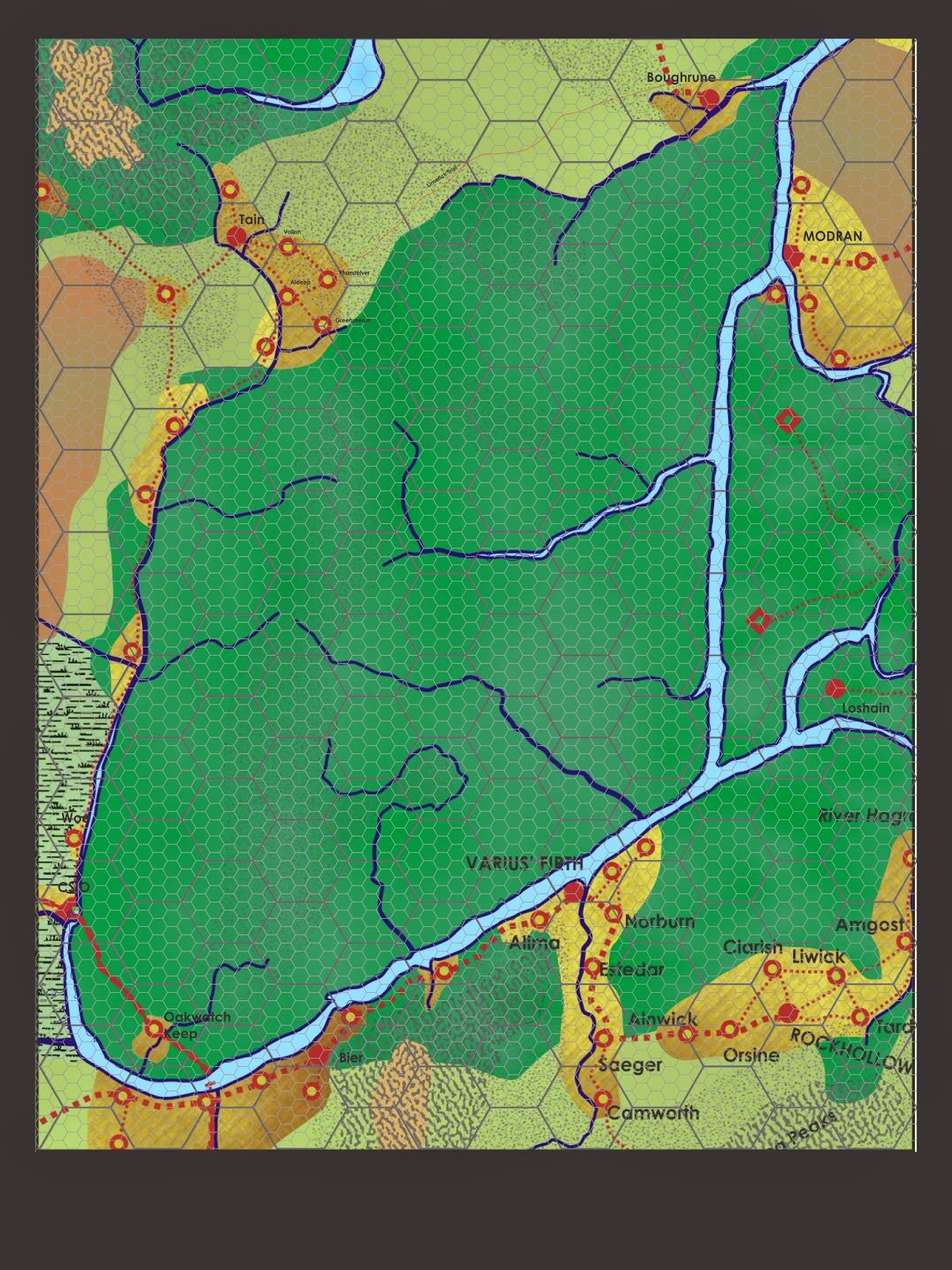
For example the players start off knowing this about the forest (the big green expanse in the middle).
Dearthwood+Forest+Rev+3.jpg


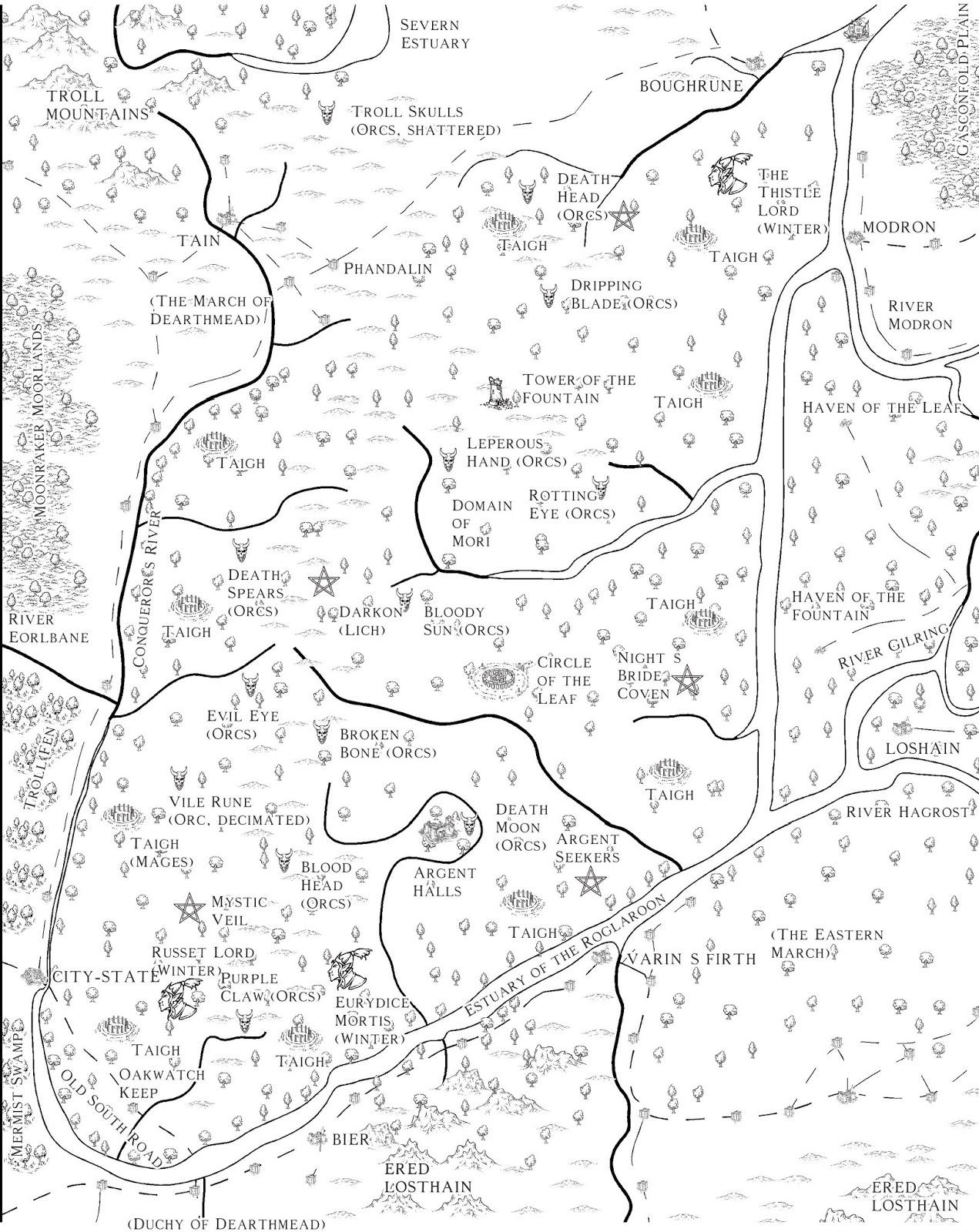
In reality what in there is this
Forest%2Bof%2BDearthwood%252C%2BPoetic.jpg

Some elements have connections to the outside and some don't. Some of the information is extremely dated with the last accurate update occurring centuries ago for example the Argent Halls. Some are quite current if you happened to come across the right people or the right lead for example Taigh (Mages), Argent Seekers, and Night's Bride Coven. While other are effectively part of the known world and just has to be visited like Oakwatch Keep.
 
Tell me more...

The very short version is that there is a giant disk covered in a dome floating in the void. The souls of dead people from different eras on at least 21 "Living Worlds" are deposited there, where a race of semi-sentient colour-coded beings incarnate those souls, drain their memories, and then release them. For 9998 years, this has more or less continued, except that the Necrocarcerus program is coming to an end in the year 10,000. Because the transmission from the Creator explaining the purpose and goal of the Necrocarcerus program was interrupted, no one knows what this means or if it will even happen.

You play "citizens", people incarnated in more or less working plasticky bodies. The economy is in a shambles so you can't get a job, the world has regressed technologically since a peak about 3,000 years ago, and all sorts of garbage like gods, demons, etc. are angling to get in. You can try to escape, get rich, get your memories back, whatever. A lot of the humour and weirdness comes in from fine-grained details - druids are middle-management of the utility companies,

Here's a link to a post with the overall setting map, including major rail lines. Here's a Lore Garbage post after Alex Chalk asked me some questions. Here's another early post that explains "Who do you steal stuff from and what do you steal from them?" Perhaps most importantly, here's the huge house rules document for S&W Complete that emerged across the course of the campaign.

Here's three posts I made about specific subsections and some of the points and things of interest in each area:

1) The Far Lands
2) Ocean Null
3) The Kingdoms of the Saved

And here's the total sum of the planning documents I had to run a one-shot at Lozcon in 2016, titled "Ribshack of the Demon Prince".

This post shows you the main Miro planning board I used for the two year weekly campaign, along with a few details of adventures they went on at a relatively early phase in the campaign (before the first half was done). This board was completely player facing, and organised much of the details of what was going on, so that I only had to hold back a minimal amount of information and material from my tables.

I've run Necrocarcerus both online and off, but the big campaign for it was run online on a weekly basis. It started off as a hexcrawl, then transitioned to a railroad (literally) when the characters got on a steam train and each adventure took place when the train paused for a few hours to refuel or cool down or ran into trouble. Then was just opening up back into another hexcrawl at the end destination when we decided to give someone else in the group the chance to try running something, and have me take a break.
 
Shout outs to Rob. I don't think anyone here would object to calling him Mr. Hexcrawl. Points of Light, Wilderlands Refresh and Blackmarch. STALP IT IT HURTS SO GOOD
 
Shout outs to Rob. I don't think anyone here would object to calling him Mr. Hexcrawl. Points of Light, Wilderlands Refresh and Blackmarch. STALP IT IT HURTS SO GOOD
Appreciate the shout out.

And hard at work at the next iteration. The first project is four 12" by 18" maps encompassing the area in the red rectangle. It does reuse previous material like Blackmarsh but combines the Wild North and Southland. Along with new material that fill out the surrounding territory. It will also serve as the test bed for the other maps I plan on doing.

Finally like the Wilderlands, I have one giant master map that I am cropping the smaller maps from.

1637687030230.png
 
The very short version is that there is a giant disk covered in a dome floating in the void. The souls of dead people from different eras on at least 21 "Living Worlds" are deposited there, where a race of semi-sentient colour-coded beings incarnate those souls, drain their memories, and then release them. For 9998 years, this has more or less continued, except that the Necrocarcerus program is coming to an end in the year 10,000. Because the transmission from the Creator explaining the purpose and goal of the Necrocarcerus program was interrupted, no one knows what this means or if it will even happen.
I dub this campaign, "Y10K".
 
Here's a "hiking map" from Melan's latest review of In the Shadow of Tower Silveraxe

1638288589254.png

In the comments:

Settembrin said:
Cover is nice, hiking map moreso, but the hexes make me suspicious: if I have a hiking map, I can have a continuous wilderness.

So tell me I'm crazy! Settembrini is (un)clearly implying that there is some weird hard-wired connection in most people's minds between the presence of hexes on a map and a weird, disjointed-kind-of-movement in discrete-actions that produce it's own (unattractive to me) mini-game. A "hex crawl" is somehow different than moving across a continuous map with hexes on it for distance and scale.
 
So tell me I'm crazy! Settembrini is (un)clearly implying that there is some weird hard-wired connection in most people's minds between the presence of hexes on a map and a weird, disjointed-kind-of-movement in discrete-actions that produce it's own (unattractive to me) mini-game. A "hex crawl" is somehow different than moving across a continuous map with hexes on it for distance and scale.
I don't get a sense there is a general "hex crawl" form of play. Only an individual author idiocentric approach. For example I use hexes because their utility in measuring and as a handy reference location. But they are not a special gameplay elements for me. I could do what I do without hexes, it wouldn't be as easy to use the maps.

I have one of these in my dice box and have used it from time to time. But generally a hex grid is good enough.
1638291213688.png
 
So tell me I'm crazy! Settembrini is (un)clearly implying that there is some weird hard-wired connection in most people's minds between the presence of hexes on a map and a weird, disjointed-kind-of-movement in discrete-actions that produce it's own (unattractive to me) mini-game. A "hex crawl" is somehow different than moving across a continuous map with hexes on it for distance and scale.

Hexes for me are a unit of exploration primarily and an abstract unit of movement secondly. Like "We slow down and search this new hex for areas of interest" or "We use the deer trail to move through this hex swiftly".
 
Okay, let's see if for Squeen's edification I can do a quick 'example of play' here. This is a summary of some travelling in about half a session in my home game.
Random encounters and most of the actual hex contents are omitted. This is just the back-and-forth of travelling through my hexmap.
The players are moving through dense jungle and can travel 2 hexes per day.

Day 1
Me: What's the plan for this session?
Players: We want to look for those ancient burial mounds that the locals mentioned. We will head back to their camp and go on from there.
Me: Great. You head along the trail out of town [hex 0701, 0702] until you reach the cliffs [hex 0602]. Climbing down takes half the day, like usual. At the bottom, you enter the jungles. It is raining. I assume you are going your usual route. You reach the waterfall [hex 0703] by the time it gets dark. Everyone mark off a ration.

Day 2
Players: Let's follow the river to the goblin fort, then turn south.
[The group is navigating by familiar landmarks, since they are in dense jungle. Going along the river is quite handy.]
Me: Okay. You reach the goblin fort around midday. [Hex 0704] You don't see any patrols, and the rain makes it hard for the guards to spot you.
Players: Great, let's avoid these guys.
Me: You head south away from the river. [rolls for getting lost in the jungle away from landmarks, they are OK for now. Roll for discovery of hex contents, they found it!] Towards the end of the day, you come to an old Imperial watchtower built on low hill, crumbling and covered with vines. [hex 0604 - fight a giant locust, search the tower, find treasure and clues, etc]

Day 3
Players: Let's keep going this way to that old monolith we found before. From there, we'll turn east to find the wildmen.
[Because the group have been through these hexes a few times before, their chance to get lost is much lower when striking overland. Let nobody say I am without mercy.]
Me: Okay. Halfway through the day, you find the old monolith [hex 0505]. Turning east from there [rolls, another successful navigation check] you find the wildmen camp [hex 0506] at the end of the day. They are friendly since you helped them out last time. They offer you hospitality, so you don't need to mark off a ration today.
[Players hang out with the locals, blah blah]

Day 4
Players: Okay what did they say about these old mounds again?
Me: They point to the south and say they're about a day and some that way.
Players: Wicked, let's go.
Me: Okay, after a few hours you pass by the colourful stone towers you explored some time ago. [Hex 0405 - This is the extent of the group's exploration up until now. From here on, I roll regular chances to get lost] You travel on past them, progressing further south. The jungles here are a little less dense [hex 0306], but the terrain is still tough to get through and the rain shows no sign of slackening.

Day 5
Me: Continuing south. [They travel through hex 0206. They pass right by the burial mounds, which are in hex 0205. Oops!] You travel the jungle most of the day, and in late afternoon come across the crumbling remains of an old stone roadway, running east-to-west through the jungle. [hex 0106. Can't miss this as it runs across the whole hex]
Players: Okay, Leliana the witch is going to cast Wizard Mark on a piece of road so we can find this spot again. Now which way do we go? The wildmen didn't say anything about this. [debate debate] Let's keep going south, maybe it's further on.
Me: Okay, you travel a few hours more before nightfall [still in hex 0106]

Day 6
Me: Continuing south, the jungle is a bit less dense this way. The terrain is still rough and hilly, but the rain thins out some and you can see farther. [hex 0005 - Roll to get lost is easier. Hex contents are easy to see from anywhere in the hex anyway, no roll needed] After a few hours you spot a greenish-blue light in the sky like a spotlight on the clouds. It's ahead of you to the right.
Players: Weird! let's go towards it and check it out.
Me: Okay. You reach it around midday. A crumbling, ruined curtain wall surrounds a silver tower wrapped in a pillar of blue-green light. [describe the tower, the players go inside and immediately get scared]
Players: Fuck this! Let's get back to that crumbling roadway.
Me: Okay, you reach the road [hex 0106] by the end of the day.

Day 7
Players: [debate debate.] Let's follow the road west. Maybe we will reach the cliffs and get a sense of where we are.
Me: You guys follow the old roadway west. It isn't much easier to travel on this than through the jungle, it's so cracked and old. At least you can see a bit further. [no chance of getting lost. Pass through hex 0105]. In the late afternoon, as the roadway gradually ascends, the cliffs coalesce out of the mist and rain. The jungle thins out here [hex 0104] and gets more sickly-looking and dead the further you go. Finally, at the base of the cliffs, you come to a wide clearing, maybe 500 meters or so. Nothing grows here, and a low fog covers the ground. Up ahead is a great pit, and an earthen ramp leading to a cave entrance of some kind [Hex location 0104 - the road leads right to it].
Players: Oh boy...

players route example 1.jpg

Hexes are a tool that allows for placing locations and tracking player movements in a wilderness to a playable level of accuracy. This is Dungeons & Dragons, not Compasses & Cartographers. The group is 'inside the hex' in a general sense. I don't have to know exactly WHERE unless they are at a particular keyed location.
These locations are also a little bit 'floating around in the hex,' because players can pass through a hex several times, even travelling the same route in the same direction without finding one. Common sense must be applied here (you have that, right?). If the goblin fort is built beside the river, the players will automatically discover it travelling along the river. For the watchtower in the middle of an overgrown jungle, the players could (and did) travel through that hex many times before stumbling across it. An understanding of your terrain and sight distances are obviously vital here. This trip would have looked completely different if the PCs were marching through amber waves of grain.

Hexes allow for simplicity, ease of use and crucially, a low cognitive load on the DM.
They don't interfere at all with the players' sense of seamless exploration and travel.
There is no "mini-game."
There is no randomness - all these locations are either modules or my own creations, placed on the map long before the players got there.
You are objecting to problems that don't exist.
 
Back
Top