Hex Crawls

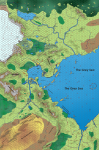
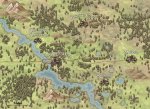
Inkarnate has a hex overlay, for whatever that's worth. I didn't overlay it myself but it makes pretty results very easily:
KukovaitsDomain2.jpg
 
Inkarnate has a hex overlay, for whatever that's worth.
Yeah so does Worldographer, but I can't remember if it is available with the free version.

The thing that does keep me coming back to Worldographer (and the reason I bought the paid version) is the "map levels" function, which lets you zoom in on a hex to make a more detailed group of subhexes. So you make your world with say 24-30 mile hexes, and then you tell the program to make a "continent level" map, and it populates all the large hexes with, say, 5-6 mile hexes - randomly generated but consisting with the top level hex. And then you can make another "kingdom level" map with, say, 1 mile hexes. And there is a beta version that makes "province level" hexes if you want to zoom in even more.

I would probably give HexKit a try, but I have SO much invested in my Worldographer maps that would have to be re-done...
 
I would probably give HexKit a try

Yeah man, someone here encouraged me to get in on that Campaign Cartographer Humble Bundle which I bought, installed and promptly forgot. Worldographer was easy to figure out and just got in first. Probably the same reason my group is stuck on Roll20 even though there are some increasingly more appealing options out there...
 
Yeah man, someone here encouraged me to get in on that Campaign Cartographer Humble Bundle which I bought, installed and promptly forgot. Worldographer was easy to figure out and just got in first. Probably the same reason my group is stuck on Roll20 even though there are some increasingly more appealing options out there...
I like Campaign Cartographer, but I just don't have time to make those kinds of maps any more.
 
Magestic Stars sounds great @robertsconley !

Would this be a Cepheus Engine hack? I am reading the Traveller Book per Grognardia and the mix of hard sci fi and DM Fiat reminds me of ODnD

I don't have a metric for this but it justifys as non DnD system in a way few RPGs do? I can see myself liking it! More than DnD BX in space like Stars Without Number ( ideal generation and DM tools withstanding)
 
Old thread, but that has never stopped anyone here.

I've been thinking recently about I want to structure and present the environment that I created for a new campaign as a map for the players. I'm not a fan of grids being visible to players, as I personally believe it encourages a board game mentality in which the map is the game, instead of being an in-world object that communicates in-world knowledge about a physical environment. At least for me, it gives my lazy brain an excuse to not bother with imaginig a person percieving a striking environment. I also never felt happy with a physical environment consisting of segments, and a person could very well be in the same 28(?) square mile area as a whole city and never notice it. Much less so a single cave, tower, or statue.
So I simply don't design the environment around hexes.

What I am having in mind how wilderness travel and exploration should look like is much more along the lines of pointcrawl. Travel happens almost exclusively along roads, trails, rivers, and shorelines, and you're only going to discover any sites if they are on one such path or visible from the path.
But I find Chris Kutalik's original pointcrawl map examples have a number of shortcomings, at least in regards to my specific needs. Which might in part ecause of my prepared scale for maps. His Slimbering Ursine Dunes and Isle of the Eld adventures are both designed as single compact areas. But I love the baggage train through the wilderness on weeks long expedition stuff. That great Lewis and Clarke shit! That means you can't draw in every small river or trail that players could use for navigation when creating the innitial map. Only the major highways and the paths that connect to pre-planned sites. But what if the players decide to take shortcuts cross country? Or new sites have to be added to the map between existing sites? That big square boxes and lines map style doesn't really work well for that.

What I think should work really well for this is a hybrid approach that uses both hex and point elements. Which I guess you could call Pathcrawl.
1a. First I draw the map in freehand. Just a map with no hexes or anything. Mountains, forests, lakes, islands.
1b. Then I determine the primary rivers and mountain passes that define the basic natural path network.
2a. After that I start adding major constructed sites like towns and castles that I want to have in the game area.
2b. Followed by the primary roads that people would have build to connect these sites.
3a. Next come any secondary sites that I want the players to be able to get instructions for to reach them by asking around for leads or picking up rumors.
3b. And then connect them with secondary trails and rivers that players are likely only to use if they are specifically looking for the site at the end.
4a. And finally I am adding tertiary sites that the players could spot while traveling on the primary and secondary paths.
4b. If they are visible from really far away, also add tertiary paths. Since the players are heading to a big object they can see in the distance, these paths don't have to follow any natural or constructed features on the ground.

Now, after the map is done, I can overlay the hex grid on the map and count the number of hexes that each path between any two points is going through to determine the distance. If you wanted to, you could note down that distance next to each path, but I simply leave the hexes on.
If at any point the players decide to go off the obvious paths and take a shortcut through the trees, simply draw a new path on the map. Count the hexes it passes through and you have the length of the path.
If a random encounter happens at any point in the wilderness, and the players decide to follow fleeing enemies, trace back the trail of killed enemies, convince friendly NPCs to be taken to their home, or they get taken prisoner, just mark the lair somewhere near the current position and draw a line for the path to get there. Again, count the hexes to figure out the length of the path.
Someone complained about the clear plastic grid in the Forgotten Realms box. I think that idea is briliant for counting hexes to determine path length on a non-hex map. Though I doubt many people would have drawn new sites and trails on the big fancy paper maps.

Only slightly related to the above, but another thing that had been briefly brought up earlier:
I think procedurally generating content on the fly is not about letting GMs be lazy and run games without preparation. All the above is preparation that I would do in advance before even starting the campaign. (Though local maps for sites will be drawn and keyed as it becomes clear the players might go there soon.) Randomly determining a few key parameters as a starting ideas to develop more sites would also fall under this preparation.
Actually rolling up stuff during play is all about random encounters while travelling. And I think these are hugely important for a wilderness campaign, and must be randomly rolled, not prepared and set up in advance. With random encounters you establish than any preparations and precautions the players take before a journey will determine how well or poorly they will be able to deal with what they encounter. If encounters turn out easy, it's because the players prepared well and were lucky. It's not because the GM decided to only give them as much opposition as they can handle. And the reverse is true as well. The GM does not decide when the PCs should get badly beaten up. The only two variables are player planning and dice luck. GM whim is not a factor. (Sure, writing the random encounter tables is the GM's work, but that's different.) In most situations where a random encounter happens, there is a possibility that the players might want to find the creature's lair, and they should be able to do so. Lair generation on the fly can be quick and dirty. Roll another group for the the same creature type but this time as a lair, and grab one of a dozen or so prepared empty lair maps.And done. Should the players end up robbing their stash, that's where randomly rolling treasure comes handy.
If you have a week or two time and want to get big and fancy, you can design a whole dungeon to house the lair. A simple stockade with tents or a small cave with three chambers where the whole group lives is for when you need to improvise something quick
 
Sounds kinda hex-y but what I dislike is:
  • discrete hex grid movement --- like a video game
  • the horrible hex-coordinate system for marking keyed locations
  • too much randomness (seems lazy)
Honestly, my dislike is mainly the last bit.

For points #1 and #2 I'll note what I've learned from the last chapter in Procedural Generation In Game Design (https://www.amazon.com/Procedural-Generation-Design-Tanya-Short/dp/1498799191): you don't have to make all the regions hexes. E.g. you could have a number of regions that are just segments of the length of a given river, and others that are sections of plains, and others that are mountains and valleys between them. And you can use any keying system you want including just approximating the center with GPS coordinates or some analogue.

As for the third... you have a point. If I were running a "hexcrawl" or region-based equivalent, I'd probably use hidden Markov chains and layering to add interconnections and therefore meaning between regions. E.g. when you're close to the site of a lost Mind Flayer ruin, mind flayer stuff get added to the Rumors table, the Weird But Incidental Features table (equivalent to the Empty Rooms table of a dungeon, where "empty" means "not a monster, not treasure, not a trap" and includes interesting-but-useless stuff like monster trophy rooms, map rooms, and kitchens), and treasure tables. And my implementation method of choice would probably be a computer program instead of a list of tables, because honestly that's just easier.
 
What I think should work really well for this is a hybrid approach that uses both hex and point elements. Which I guess you could call Pathcrawl.
I have long thought that a hexcrawl is what happens when you leave the road.
 
Paths don't have to be roads. Paths only exist on the map to have some information on what terrain the party will pass through while traveling between two sites, and how long the diatance, and accordingly the travel time is.
I explicitly wanted an easy way to add new paths to the map during play with my tweaks to the pointcrawl system.
 
Say instead, "clear routes". I was going to say "obvious routes", but a mountain pass, for instance, can be a clear but hidden route.
 
What people miss in Wilderness travel is situational awareness. Travelers are not as blind as many RPG author think nor do you need modern orienteering aides to make a proper go of it.

Which is why in my book this map is OK.

1654784476502.png

The grid is there because it is an effective method of communicating scale. Although when I use Roll20 or a VTT the built in scaling tools and rulers means I can omit the grid.

What I depict (and show to the players) on this map are the large scale features that can't be missed.

When you zoom in the best the players will get this. Which is a a handout given after an extensive debrief of a NPC knowledge of the region. This handout is a summary of what was told formatted for ease of use and omits important details that the NPC didn't know about. As you can see I drew this using a handrawn style rather than the cartographic approach I took above.

1654784722167.png

If the players didn't have this then they would have to wander the landscape exploring. I handle this by putting a token on the map indicating where they are. Ask where they want to go. And if it not obvious what route they intend to take.

For the following example, I don't have access to the blank map I used in the actual game so you will have to imagine I was using the above without all the notes and smaller details.

For example the PC decide to start out at the Quarry H. They know about that because that is general knowledge in Abberset. They strike west travelling along the highest ridge until they see the Quilli Swamp and then will decend to reach the easternmost edge on the north side of Nopanzin Creek.

The player choose the ridge route because they know they have the best line of sight on high ground.

This is the route I envison them taking. Note they don't actually draw it out any more you would draw it out if you headed to the local woods. Most of the time the players trust that I will give them the benefit of the doubt that their characters know what they are doing.

1654785255679.png

I will move the token along the route and stop it at the first X. And tell them they see a small forest to the northwest on some high ground. That there are some ravines and small valley separating them from the forest. The group probably just take note and say they continue on. Elapsed time in the session two or three minutes.

Next I stop the pog at the second X and tell the group that to the south, down in the creek valley is a village with fields and smoke from cookfires. The party decides to note this also and investigate it on the way back.

They have a random enounter (I rolled) just as they started to descend toward Quilli Swamp. They deal with it, and the arrive at the swamp. Elasped time around 5 minutes for the journey stuff. About 25 minutes for the encounter (I was using GURPS For the campaign, it would have been 10 or 15 minutes for the encounter with classic D&D).

After they dealt with the swamp they would find the creek and follow it back to the village and see what was up with that. If they didn't encounter anything I would describe the journey in a minute or two.

A key element is that the player know they don't have to play twenty questions. What I call out something it because I adjudicated it as something their character would naturally noticed. For things like trying to find a hidden camp like Rebel F on the big map, they trust me enough to make the hidden roll when they are searching for it. When it face to face, I like to use a dice tower and have them make the roll and only I see the result.

I do things this way because I camped and hiked throughout my life along with my experience with outdoor boffer LARPS when it was my main thing for a decades in the 90s and early 2000s. I use that knowlege to paint a more realistic picture of what the character's situational awareness is. Which generally is a lot less anal-rentative than what most RPG systems depicit it to be.
 

Attachments

  • 1654785186207.png
    1654785186207.png
    101.4 KB · Views: 1
Here's what I did in Irradiated Paradox of the Volatile Skies, which I am currently playtesting. I gamified the rules and clearly presented them to the players so that they would understand that it is a sub-game and that they have control over it:

1654860401078.png

here is the small-area map that I presented to the players including major features. Beside it is a Quick Ref and Movement Cost Ref to help me out:

Untitled-1.jpg

They can move through this area very quickly if they stick to the road or have previously explored the terrain. Otherwise they can get bogged down for quite a while finding their way through the rugged wilderness and looking for any interesting features. This was further simplified by two Point Crawls with pre-measured travel times and side-paths noted along the way. The guys have had a pretty good time with this, but I have to admit they've pretty much ignored the front-facing mechanics.

They're now dicking around with the cult up in the fungus mountains at the top-right. There's a smaller scale 'Rot Crawl' in the Fungal Depths below the enormous shelf-fungus that form the mountains. That is going to be an experiment with on-the-fly procedural generation that I am very much looking forward to:

Untitled-2.jpg

Very much like Isle of Dread, I intend to present the players with the blank hex map and let them go nuts filling in the blanks. There's been a lot of front-facing hex-hate here. Something something reduces immersion etc. I don't know. Maybe you crusty old grogs are right. On the other hand, se had a pretty good time filling in the blanks of X1, and I'd like to see if it will be the same here.

Once again, note the use of small, contained areas. I believe CRPG's like Witcher 3, Fallout(s), Skyrim and even BotW pretty much nail it when it comes to travel distances. There are too many wilderness products with hundreds of miles of nothingness between locations. That may be a product of the North American influence on the game. Honestly, there are parts of Europe where you could have a swim at the beach in the morning and go skiing in the afternoon. (or so I'm told. this asstastic pandemic has had me cooped up in sunny Berlin for most of this posting 😭 )


For newcomers interested in the rest of the adventure, you're welcome to read along and see me get pummeled with excellent criticism over in this corner of the forums...
 
Once again, note the use of small, contained areas. I believe CRPG's like Witcher 3, Fallout(s), Skyrim and even BotW pretty much nail it when it comes to travel distances. There are too many wilderness products with hundreds of miles of nothingness between locations. That may be a product of the North American influence on the game. Honestly, there are parts of Europe where you could have a swim at the beach in the morning and go skiing in the afternoon. (or so I'm told. this asstastic pandemic has had me cooped up in sunny Berlin for most of this posting 😭 )

I'd blame this on Tolkien, to tell you the truth. Sure, there was an in-story reason why Middle-Earth was depopulated (Sauron getting things ready for the killing blow) but people tend to miss that and think that fantasy worlds need to be vast wildernesses. World of Greyhawk sealed the deal (especially with the ridiculous scale on the campaign map).
 
The guys have had a pretty good time with this, but I have to admit they've pretty much ignored the front-facing mechanics.
That's because it is an associated mechanic. Things they expect will make them move more slowly, in fact make them move more slowly. The numbers only matter in terms of the relative amount they are being slowed down, and most of the time won't need to be consulted.

A comment on the getting lost mechanic. I see this a lot, where you have an equal chance of wrongly going in any direction. I don't know if that is how it works in RL, at least unless you have VERY cloudy skies AND cannot see a landmark to aim at. Most of the time you know the general direction you want to go, but what happens is you are forced by obstacles into lateral movement until (a) you get boxed in and have to turn around, (b) you lose sight of your landmark and have to start guessing, or (c) if you can't see a landmark, you end up moving laterally further than you thought, and when you reorient to go in the cardinal direction you want, end up bypassing your target.

That (c) makes me realize that with your "getting lost" rules, in addition to the possibility of going in the wrong direction, there needs to be a consideration of underestimating or overestimating the distance you travel.

I agree with @robertsconley that a high degree of DM fiat is appropriate - as long as the DM has sufficient RL outdoor experience to pull it off. Unlike dungeons, where every player has RL experience with rooms and corridors, travel in wilderness without roads or even paths is not something everyone has experience. So for a home game with a DM who has the right knowledge set, DM fiat is fine, but when creating for a market that includes people who have spent their whole lives in a city, you really need to build a system.

Re: player maps, I have been considering using software to create a hex map where the grid is not player visible (or I suppose using tracing paper over an empty grid to accomplish the same thing) so that it looks more organic. I haven't tried it yet, though (nobody ever leaves the roads).

I'd blame this on Tolkien, to tell you the truth. Sure, there was an in-story reason why Middle-Earth was depopulated (Sauron getting things ready for the killing blow) but people tend to miss that and think that fantasy worlds need to be vast wildernesses. World of Greyhawk sealed the deal (especially with the ridiculous scale on the campaign map).
I think part of the problem is unrealistically high travel speeds. People think you can walk 8 or more hours at 3 or more miles per hour in a straight line over prairie an you will make 24-30 miles per day. You can't consistently travel that long (travel cross country is tiring, even on plains), it is never that fast (again, you won't make top speed on plains or even poor roads), and it is never a straight line. And horses can't travel twice as fast for a full day while carrying a rider; off the top of my head, I think averaging 4 mph makes more sense.

But when you peg travel at 24-30 miles per day, and you want the sort of travel times you see in the ancient and medieval world, then the world needs to get bigger to accommodate it. And now it is ingrained; when he was designing Eberron, Keith Baker had to fight with WotC to make the continents smaller, with limited success.
 
Back
Top