Advice for a sandbox campaign

Ok. I do get the selfless/selfish distinction, but what is neutral then?

I'll go back to the Han Solo example. He is selfish, but not evil. As long as he gets what he wants, it's live-and-let-live. Evil is selfish, but it takes the additional step of enslaving others to its will---a selfishness that eats the world (e.g. Morgoth or Ungolant).

Babys and children also often act selfishly...

Hmm?...

Alternatively (and conceptually simpler), evil can be something primordial that is fundamentally anti-life.

Also, I think a lot of game hang-ups with alignment pertains to enforcement on PCs. I think it's easier to apply for NPCs, but---like many things in gaming---if you dig too deep it just gets messy.

However, using our capacity for reason to ponder the nature of good and evil is not necessarily a waste of time, so Happy Friday folks!
 
Last edited:
Problem is when you step over a mostly universal definition to pick at exemptions.

Yes, babies can be selfish. No, you'd be hard-pressed to call a baby "evil". HOWEVER, in the context of D&D, babies don't get statblocks and alignment designations in a Monster Manual. You could also theoretically argue that a baby is not evil but that selfishness is evil (that the act is evil, not the person), or that evil can only be caused by something with the ability to understand what its doing and how it affects others.

Same with Han Solo - he doesn't seem evil in how he's depicted in the films (protagonists rarely are), but his selfishness is kinda evil. If I instead framed it as "I have an NPC who smuggles illegal contraband, openly fights against the law, shoots people in crowded bars, and only ever cares about himself", then it's not a stretch for you to assume I'm talking about a Chaotic Evil NPC. Hell, if the Empire weren't such dicks, you'd almost hate Han Solo for helping blow up the Death Star, killing hundreds of thousands of people.

At the core, evil acts are acts of selfishness. "Enslaving others to its will" is a selfish act, but it is not the catch-all of evil acts. Theft, for example, is an evil act but you wouldn't say that it's "enslaving others to a will". However we can re-define theft as a good act instead of an evil one by virtue of the rationalization behind it (the Robin Hood example demonstrates), which is specifically the case because the act becomes selfless instead of selfish (stealing to feed the poor).
 
...you'd be hard-pressed to call a baby "evil".
Darn! I was really hoping someone would call babies evil. ;P

You make a good argument. (But what is neutral, inaction? What about selfishness that appears to not hurt others---like gluttony?)
I'm going to hang back for a bit and ponder. Hopefully someone else will chime in.
 
Darn! I was really hoping someone would call babies evil. ;P

You make a good argument. (But what is neutral, inaction? What about selfishness that appears to not hurt others---like gluttony?)
I'm going to hang back for a bit and ponder. Hopefully someone else will chime in.

Neutral is the non-adherence to a specific ideology (in this case, neither inherently selfish nor selfless, but rather more prone to sway to either depending on the situation). Also, selfishness that doesn't hurt others is still technically evil - there's a reason that gluttony is considered one of the seven deadly sins.

It complicates things because the labels of evil, good, or neutral imply a universal constant in the behavior of someone, when the reality of the situation is that actions/minds are prone to change depending on circumstance, so at best we get an approximation that something has an alignment. For this reason, I eschew the alignment system when I play D&D, as per my original point about it in the thread.
 
Last edited:
Funny, I just read an article by Keith Baker (the guy who made the Eberron campaign setting), where he uses the exact same example - a bartender watering down his drinks.

Not a coincidence, I run Eberron. That’s right, I run a 3.5e published campaign setting using 4e as a system with a 1e design/play aesthetic and 1e/BECMI modules. I’m thinking of making my avatar a unicorn.

Ok. I do get the selfless/selfish distinction, but what is neutral then?

This conversation is moving too quickly for me to keep up, but I wanted to back up and respond to this.

Both selfish and selfless are meaningless unless you attach actions to them. There is a significant difference between a person who is selfish, and therefore will not lift a finger to help someone, and a person who is so selfish he is willing to harm others to get what he wants. The former is neutral, the latter is evil.

Selfless seems like it will automatically be good, but that is only the case if the person does something about it. Recently someone I know was trying to convince me to take a certain action because she had personal knowledge regarding the wrongdoing of a particular individual, and she felt badly for the victims. “That’s great,” I said, “are you willing to testify?” “No.”

As for the bartender example, watering down drinks is an evil act if it satisfies a want, not a need. Watering down drinks to feed your family is a neutral act. Watering down drinks to support the rebels against the evil overlord is arguably a good act.

@DP, the Seven Deadly Sins are a social construct. A sin that does no harm is only evil because a religion or other social protocol has decided it is so. Granted, historically activities may have come to be defined as sins because they led to social harm, or with older technological levels could have amounted to actual harm.

Gluttony, for example, does harm in a community without food storage technology where everyone is starving in late winter; but is it hard to look at it in the same way at a time when high calorie, low nutrient food is actually cheaper than low calorie, high nutrient food. A lot has changed since the fourth century.

But on a broader level, defining any non-harmful activity as a sin is just a method of establishing societal norms. It almost doesn’t matter what the activity is; I think it is more about establishing a structure than what that structure looks like. Now that I think about it, the virtue-sin axis may have more in common with law-chaos than with good-evil.

Anyway, I don’t use rigid definitions for the alignments, that’s why I like to add personality for context. Sometimes lawful means being a strong proponent of the law, sometimes it is a belief in social order, sometimes it is self-discipline. Sometime chaotic means strongly believing in individual freedom, sometimes it is anti-establishment, and sometimes it refers to poor impulse control. For me, it is a useful shorthand when further modified by context.
 
Last edited:
Not a coincidence, I run Eberron. That’s right, I run a 3.5e published campaign setting using 4e as a system with a 1e design/play aesthetic and 1e/BECMI modules. I’m thinking of making my avatar a unicorn.
Use the weird black unicorn from the 1e DMG. It looks cool.
Good points about sin. I thought much the same.
 
"As for the bartender example, watering down drinks is an evil act if it satisfies a want, not a need. Watering down drinks to feed your family is a neutral act. Watering down drinks to support the rebels against the evil overlord is arguably a good act."

This sounds like "motive" and reminds one of legal procedures for criminal prosecutions. Nothing wrong with that, but it's interesting to note that the alignment debate is taking the same course/form as a legal proceeding.
 
Nope, it's nothing like a legal proceeding. Motive, or absence thereof, is not a defence, it is only evidence (and barely that). What I am talking about is justification; in law this would be the defence of necessity, which is not universally accepted in all common law jurisdictions (unless you count self-defence, which is a specialized form of necessity defence).

The defence of necessity is available in my jurisdiction, but that particular form of the defence would not help any of the bartenders in question. Here it has to be an urgent situation of immediate peril, with no reasonable legal alternative, and the harm inflicted must be less than the harm avoided. The good and neural bartender could arguably argue the third point, but they would lose on the other two.
 
A debate about alignment! What is this, the local bar?? I've had many an argument about this with my local gamer pals while three sheets to the fuckin' wind, and it's always fun. One of them is a philosophy major but I've read more of Appendix N than him so it usually ends in a draw!

But seriously folks. Really good stuff here, and I agree with a lot of points from many of you.

I am of the opinion that alignment is one of the many "RAW traps" in D&D. That is to say: if you just read the text of the rulebook and don't spend any time thinking about it on your own, you are in deep trouble. Many of these have been discovered over the years, and they usually exist in the overlap between the rules mechanics (like hit points, armour class, whatever) and the game world you're playing in (whether it's Athas, Ravenloft, Faerun or your own world). I'm sure you guys can see what I mean. As written, alignment is pretty much useless. It attempts to be a human-level moral compass, system of cosmic allegiance and a magical taxonomy all at the same time. Because it's trying to be all things to everyone, it ends up kind of accomplishing nothing.

Most of us here seem to be veteran DMs who have their own views on the subject, and honestly I think it's more important that you have a clear idea of how it works for your game. Different approaches will work for games of varying styles. My setting is a swords-and-sorcery "lost world" with cannibal tribes, witches and demon cults. I only use the Law-Chaos axis just to simplify things. I look at them as broad-strokes "cosmic football teams" almost - describing one's allegiance to higher powers, while leaving the more immediate moral decisions up to the individual. Most of the PCs are Chaotic, but that doesn't mean they are bad dudes. Inspired by this https://jrients.blogspot.com/2008/07/jeffs-threefold-apocalyptic-alignment.html

A few examples I give to my players:

The witch-hunter coming after you is Lawful. He knows order must be kept in society and you present a legitimate fucking danger to that order. He might do his job with kindness (unlikely) or be a really cruel prick, but either way your head is going on a spike unless you can avoid or defeat him. The fact that you fight monsters isn't enough to dissuade him from eliminating any and all threats to the status quo. Think of the movie The Fugitive: "I didn't kill my wife!" "I don't care."

Conan is neutral. He doesn't care about gods or the affairs of civilized men, he's in it for himself, but has his own moral compass which might differ from other Neutral characters. Classic example from The Treasure of Tranicos: "We can trust him in this matter," asserted Strombanni. "These barbarians live by their own particular code of honor, and Conan would never desert men of his own complexion to be slaughtered by people of another race. He'll help us against the Picts, even though he plans to murder us himself..."

Elric is Chaotic. His patron is the demon lord Arioch, he wields a weapon of Chaos (without suffering damage equal to the sword's ego points, see DMG p. 167). However he often fights against Chaotic foes and spends an inordinate amount of time (at least in the first book) pondering moral questions - just being Chaotic is not enough for him to be Evil. If it weren't for Stormbringer constantly killing his friends, he would do fine in many adventuring parties.

I always liked this guy's writing on the subject as a starting point (and he has a lot of other articles on that website I quite enjoy): https://www.dandwiki.com/wiki/Tome_of_Fiends_(3.5e_Sourcebook)/Morality_and_Fiends
 
Hey, this thread has been super interesting to read. I would like to respond to everyone but I don't have time for that, so I just want to share a thing you guys could use in your own campaign.

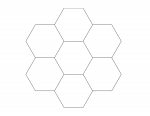
Blank hex map

HEx Map.png
(full-sized PNG so you can use it, too)


Here's how I used the hex map, maybe it will inspire you.


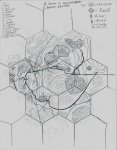
Cult of Xul's map
Xul cult map.jpg
(JPEG because nobody is going to use this)

This map probably needs a brief explanation.

First, I printed out the blank hex map above and then made a topographical map and added some features from previous modules we had done or stuff I had just made up. Watching Questing Beast's tutorials on this really helped me draw this. Each hex is 6 miles, so it will be really easy to connect into a bigger hex map. Forest and topographical features are pencil, road is pen, water is blue pen. I drew a bunch of weird little symbols on the map to represent different features.

Then, I wrote about 2 pages of history notes and came up with a (work in progress) key to the map. The numbers and features are left intentionally vague to the players, but I'll explain them to you briefly: (Note: * = a module)

1 is Hirot from Doom of Savage Kings*; 2-10 are randomly generated villages, into some of which I put details. Most notable of these is #2 - the town of Hole, an Anarcho-Syndicalist peasant town. Hole was the first place the characters went after the 'funnel.'

11-12 are ruins of towns that I am just going to freestyle/bullshit if they go there.

13 is just the Keep from on the The Keep Borderlands*. They haven't gone in that direction yet and I am not sure if the will. (read it a long time ago, never used)

14 and 15 = A and B. These are modules that the players have cleared. A is Tower of the Stargazer*, B is The Portal Under The Stars* from the DCC rule-book.

There are also a few other unmarked symbols (like a Cross and a lake looking thing) directly on the map that correlates to unmentioned modules which I have read. Hooks to these places are on the Rumor Table (possible subject of another post, but not now).

Just a bit of history on how this map ties into the 'campaign.' They got this specific map after about nine sessions running through various modules. First session was Portal Under the Stars, next one was Tower of the Stargazer, then three in Doom of Savage Kings and four in Fate's Fell Hand. Take note: Nothing from Fate's Fell Hand is on the map because it took place in a pocket dimension. At the conclusion of the 9th session and Fate's Fell Hand, they had been given a reward to instantly travel anywhere in the multiverse. They told me that they wanted to return to Hirot for the next session.

So I made this map and wrote about 2 pages of history/notes for my own usage. They got this map at the end of the 10th session, and then had it explained a bit to them at the beginning of the 11th while adding in Rumor Table rolls. The map was very useful and we referenced a lot. I suspect we will get an enormous amount of value out of this map. Hexes are so versatile. It would be very easy to tie into the Wilderlands, Hex Crawl Classics, Fight On or anything else with an expansive hex world.
 
Last edited:
I thought about leaving out this bit of criticism, since I don't really know what's going on at your table. Sorry if it offended.

I am glad you brought that up because it ignited such an interesting discussion!


When I played in that evil campaign, we only lasted about 4 sessions, but they were an excellent 4 sessions. The funniest part about having an Evil character is the role-playing. What evil means to each player is highly individualized and coming up with weird, characterful things for your character to do all of a sudden becomes a challenge. If you are doing it correctly as a player, you constantly have to come up with plans, actions and motives that are deranged, crooked, and slightly vile but often benign or inconsequential. However, one of these role-play moments should make something unusually weird or negative happen at the DM's discretion. I don't know how long it can go on for, but it's fun while it lasts.

If I am DMing a system with Good/Evil, I much prefer if the party have mixed Good/Evil alignments because it makes the aspect of 'role-playing' come out that much more. When the players are good friends, their characters busting each others balls can be some of the most memorable parts of a session. Someone mentioned that after several evil sessions you get tired of your characters own actions. That is probably true, but you can mitigate it with a mixed party alignment.

For this campaign, we run DCC. DCC has the Law-Chaos continuum only. The alignment of the characters in DCC has game-play mechanic ramifications (eg, which table thieves use, how healing works, ETC). In our specific campaign, each player controls a troupe of characters. Each character has a few sentences fleshed out about their personality so alignment rarely comes up outside of the gameplay mechanics

A good example of an Evil charactrer in an OSR gold for XP style system might be someone who gains XP by spending his gold on torture devices and gets an XP bonus for finding torture devices in the dungeon. Part of that character's motive could be trying to torture his enemies (on top of just getting filthy rich.) This character could be any class. If someone on the party had a typical good priest, this would also be a good foil.
 
Last edited:
Back
Top