Why Assassins are awesome!!!

What does the assassination table provide that sneak attack doesn't?

The table adds an insta-kill function to the thief's fairly mediocre backstab? Admittedly, the table starts to fall apart in the face of NPC's with more HD than the PC (which all boss NPC's will have). There are some hand-wavey notes below the table allowing the DM to nudge the numbers one way or the other based on the solidity of the PC's plan and other circumstances... Theoretically the death attack could be a not-insignificant thing.
 
hand-waved assassination table

I freely admit this is coming from my primarily 2-3e experience, but I broke out in hives looking at that 1e DMG Assassination Table. If you're considering tinkering with the class to make it a functional part of your campaign world, consider further codifying the steps that could be taken to augment that Table!

In romanticized media, the assassin is portrayed as meticulous and calculating. He doesn't pull the trigger until he's as close to 100% certain as he can get. A 35 or 20% certainty is nowhere NEAR acceptable odds for this kind of character. I'm looking for a guy who, if he does the legwork (with the help of his team) has a high probability of ending a boss-fight in one shot. If he's doing this all the time, then he's breaking the game for everyone, but if you provide a couple of key, assassin's notes for each boss character, that makes it clear who's open season for assassination. Everything else is a sneak attack, and assassins function as thieves 2(?) levels lower (I think) for dealing with henchmen etc.

I think there's a lot of trepidation about party balance going on here, but every class has a roll to play. For the most part, an assassin is a junior thief in the party, assisting with reconnaissance and skirmishing. Every once in a while, he can turn an arduous battle into smooth operation. On the other side, I'm detecting a lot of DM horror for their precious boss encounters. But if the character is willing to imperil themselves doing the research and recon, what's wrong with an instant kill? If you want action and excitement, imagine the hornets' nest that will be stirred up in the wake of this important person's death!

Anyway, to sum up: I'm getting shrill about this because I've been trying to get some kind of solid sniper/assassination rules going for three or four campaigns now. I'm frustrated by nerfed rules that support cowardly DMing. I agree that no one wants to sit at the table with someone who's just one-shotting everything and hogging the spotlight. So make the rules of research and recon more concrete. If every assassination requires significant preparation and support, then players will choose their targets more judiciously and involve other players in their plans. Add some details to each major NPC in the narrative; weaknesses and precautions and how much each could bump an assassination attempt one way or the other. Throw in a random leverage, generator table for other NPC's that might cross the assassin's path. Detail the black-ops wings of any organizations employing assassins in the city; their relationship to their contractors, what they demand of them, and to what degree they support them. Pack this all into an assassin's quest adventure that clearly shows how this could all work without alignment restrictions or having to exclude other players at the table.


As for this sub-class argument. Sure. Technically, we could function with just Red, Yellow and Blue. All the other colours are just variations or combinations of the three primary classes colours. But DAMN that's a lot of work and stretching the imagination and rationalizing to differentiate the six fighters in your party. Some purple, orange and green is helpful and gives the player and DM a basis to work off of. Does the game need Fuchsia? Probably not; but if a player is willing to give it an honest go and isn't just brewing up some monstrosity off the Min/Max boards, then sure, why not. I encourage anyone with profound misgivings regarding paladins to read 'The Mongoliad' or 'The Ill-Made Knight' both of which, I promise you won't be able to put down once you pick them up!! Both offer excellent insight into the lost western martial arts and the functional value of the code of chivalry.
 
In romanticized media, the assassin is portrayed as meticulous and calculating. He doesn't pull the trigger until he's as close to 100% certain as he can get. A 35 or 20% certainty is nowhere NEAR acceptable odds for this kind of character. I'm looking for a guy who, if he does the legwork (with the help of his team) has a high probability of ending a boss-fight in one shot. If he's doing this all the time, then he's breaking the game for everyone, but if you provide a couple of key, assassin's notes for each boss character, that makes it clear who's open season for assassination. Everything else is a sneak attack, and assassins function as thieves 2(?) levels lower (I think) for dealing with henchmen etc.


When it comes down to it, if the PC's do all the leg work to make a crazy plan that kills the boss NPC and it doesn't go horribly wrong... I'd just let the guy die. I don't really feel like a table needs to come into this. I love cockamamie schemes that's basically what I build my games around.


As for this sub-class argument. Sure. Technically, we could function with just Red, Yellow and Blue.

I'm putting a lot of focus right now on keeping things simple because I have players new to the genre and most of my fair is one shots so character creation happens every time. Of course all this stuff is nice to have if we have time to stretch out.
 
Sounds a bit like it renders the Thief redundant though?...
The thief levels faster and has all the other thief skills beyond Hide in Shadows and Move Silently. The thief is the dungeon specialist, and has a much wider list of available downtime hijinks.
 
Add some details to each major NPC in the narrative; weaknesses and precautions and how much each could bump an assassination attempt one way or the other. Throw in a random leverage, generator table for other NPC's that might cross the assassin's path. Detail the black-ops wings of any organizations employing assassins in the city; their relationship to their contractors, what they demand of them, and to what degree they support them. Pack this all into an assassin's quest adventure that clearly shows how this could all work without alignment restrictions or having to exclude other players at the table.
I think this is what the Assassin class brings to the table, but its mostly roleplay and DM tools for NPCs--which I find useful and fun. To me, it makes the world feel more alive and makes it easier to run NPCs.
 
To be clear --- I have nothing against assassins as NPCs. Same with Paladins. Like all the weird monsters in the MM, they add flavor to the world.

...but you don't get to BE Orcus (or one of the great hight-level elven wizards either). You must admire from afar, not own it.
 
Well, that's one reason why I started this thread...I wanted to hear people's opinions about the class and how it could stop being garbage, but also not too powerful.
I'm hearing no alignment restrictions, sneak attack damage if assassination attempt is missed, hand-waved assassination table, sniper attack....

Opinion: assassination and hacking both have the same flaw, pacing. They require lots of interaction and input between the GM and the hacker or assassin. Meanwhile, what are the rest of the players doing?

In principle I imagine that hacking or infiltration/assassination could be fun if done as a 1-on-1 two-person game, between sessions; or if everybody was playing a hacker or assassin. Failing that, maybe just give the assassin a % chance to go chat with the GM privately and learn absolutely anything he wants to about an upcoming encounter, and to start the encounter in any position it's physically possible for him to have reached.

P.S. Yes, the assassin should be treated as a special case of thief. Venn diagram assassin circle is inside of thief circle, and partially overlaps fighter circle. Some assassins are skilled warriors, some are just good at disguise/poison/social manipulation.
 
Last edited:
Meanwhile, what are the rest of the players doing?

What are the rest of the players doing when the thief is sweeping the gauntlet for traps and secret stuff?

That's why I'm suggesting making assassination a team activity. One guy is the guy who pulls the trigger; the poisoner/sniper/arranger of accidents, but all the other competencies contribute to the mission and have a role to play. Obviously, the spotlight should move around from scenario to scenario. Even when the assassin isn't the star of the show though, they should be able to research a critical NPC so that when the time comes, they can make their own contribution to the story.
 
What are the rest of the players doing when the thief is sweeping the gauntlet for traps and secret stuff?

That's why I'm suggesting making assassination a team activity. One guy is the guy who pulls the trigger; the poisoner/sniper/arranger of accidents, but all the other competencies contribute to the mission and have a role to play. Obviously, the spotlight should move around from scenario to scenario. Even when the assassin isn't the star of the show though, they should be able to research a critical NPC so that when the time comes, they can make their own contribution to the story.

Yeah, thievery has the same pacing problem that assassination and hacking do. Involving the whole party is one potential solution; although it's only viable when all the players are interested in hacking/thieving/assassination.

Splitting the party, running an offline solo session, and abstracting the activity are other potential approaches.
 
We're talking about highly trained mission specialists with an organization at their back. Depending on the organization, they could be any alignment.
Hard agree on the idea that they should be any alignment; for example, I could see a LG zealot learning such abilities to destroy EHPs everywhere. 4e includes a divine class which is essentially a paladin who has traded his benign abilities for abilities designed to murder enemies of the church, and is often described as a divine assassin.

Next, is assassination a whole character class, or is it a suite of abilities that could be applied to basically any base class?
As it often did, 4e included both approaches. There are assassin classes, but there is also a suite of specialized options that allow the creation of a sort of SOF/seal team/IMF party that includes a variety of classes, but gives them relevant spy/assassin abilities.

What does the assassin supply that the thief cannot do? What does the assassination table provide that sneak attack doesn't? Everything associated with assassins: Poison, guilds, etc are just window dressing imo.
In principle I kind of agree with this. But more than this, being an assassin is more of a job (the clandestine killing of people for money/duty) than a class. 3e nods to this by making assassin a prestige class, IIRC, and as I mentioned in 4e there are various ways other classes can get good at asassin-type activities.

.I'd like to get a decent list of about 20 different poisons and their recipes. I've started adding alchemy recipes as loot and my players seem to dig that.
Can I suggest as a starting point Dragon magazine 32, 59, and especially 81?

In romanticized media, the assassin is portrayed as meticulous and calculating. He doesn't pull the trigger until he's as close to 100% certain as he can get. A 35 or 20% certainty is nowhere NEAR acceptable odds for this kind of character. I'm looking for a guy who, if he does the legwork (with the help of his team) has a high probability of ending a boss-fight in one shot. If he's doing this all the time, then he's breaking the game for everyone, but if you provide a couple of key, assassin's notes for each boss character, that makes it clear who's open season for assassination. Everything else is a sneak attack, and assassins function as thieves 2(?) levels lower (I think) for dealing with henchmen etc.
When it comes down to it, if the PC's do all the leg work to make a crazy plan that kills the boss NPC and it doesn't go horribly wrong... I'd just let the guy die. I don't really feel like a table needs to come into this. I love cockamamie schemes that's basically what I build my games around.
THIS! I always hated the assassination table, even when I was a new player. I think real assassination should be like murdering NPCs that are unconscious or otherwise helpless, or dropping a mountain on a dragon; if the players can manufacture conditions where death ought to be instantaneous, then as long as they don't miss the shot, it should be treated as such.

Also of note, one of the 4e variant assassins has a form of sneak attack that increases in damage the longer you refrain from using it. So each round is essentially a round of study, where you try to learn your target's weaknesses, and the longer you delay, the more potent your attack (max benefits reached in round 5). Note there is no reason why the study has to occur during combat.

That's why I'm suggesting making assassination a team activity. One guy is the guy who pulls the trigger; the poisoner/sniper/arranger of accidents, but all the other competencies contribute to the mission and have a role to play. Obviously, the spotlight should move around from scenario to scenario. Even when the assassin isn't the star of the show though, they should be able to research a critical NPC so that when the time comes, they can make their own contribution to the story.
This is supported by the "seal team" party discussed above.
 
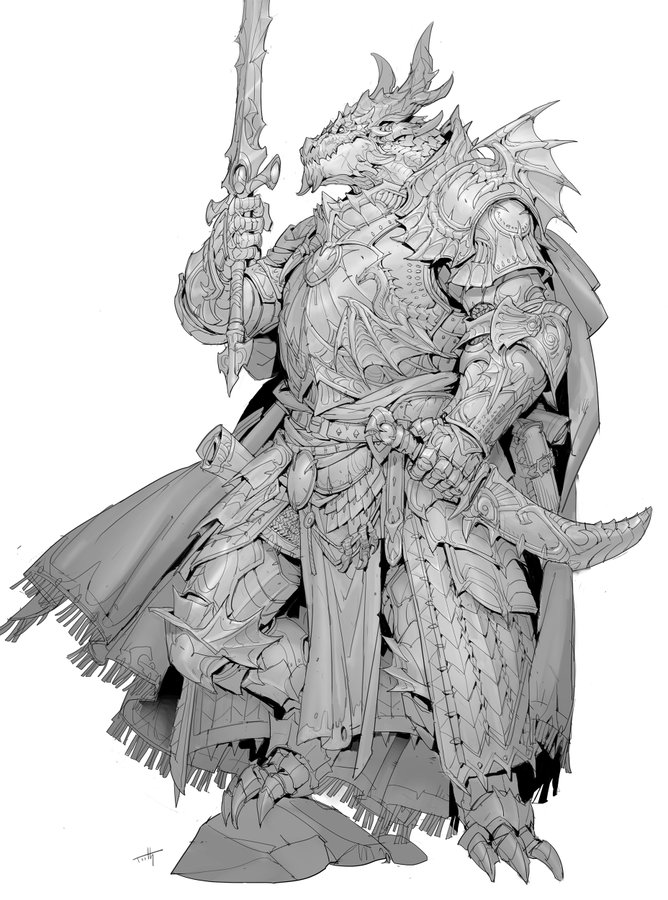
I still owe y'all a summary post on assassins, but in the meantime enjoy this sketch I bumped into today that someone drew of their Paladin "Balasar"

FwZKmkPaYAATXyP


This guy is so D&D. Sure, assassins are cool...but Paladins are still the kickass-est.

If only he could also be 50-ft tall, and just stomp on the "bad guys" while their weapons bounced harmlessly off his impenetrable hide. Now that would be some REALLY great gaming! ;)
 
Last edited:
To be fair, that's probably his end-game loadout.

I've been reading 'A Paladin in Hell' by everyone's favourite, Monte Cook, the last couple of days. It's pretty rad.
 
I still owe y'all a summary post on assassins, but in the meantime enjoy this sketch I bumped into today that someone drew of their Paladin "Balasar"

FwZKmkPaYAATXyP


This guy is so D&D. Sure, assassins are cool...but Paladins are still the kickass-est.

If only he could also be 50-ft tall, and just stomp on the "bad guys" while their weapons bounced harmlessly off his impenetrable hide. Now that would be some REALLY great gaming! ;)
Right. It is so OP for a fighter subclass to own plate armor, a bastard sword and a big dagger/small shortsword.

Like, it looks cool, so therefore it must be seriously overpowered? I don't get the objection.
 
Like, it looks cool, so therefore it must be seriously overpowered? I don't get the objection.
It's not enough he's the singularly most powerful subclass...he's also a bloody dragon on top of it!

It's really just me? You really don't get the implied ego gratification like the stink of an old gym sock and think...oh, pu-leeeeze, can't you spare the rest of us of tiny minions :rolleyes:?

The taming/normalization of the other and unbridled anthropomorphism is almost as bad. It's a freakin' manga cartoon!
 
It's not enough he's the singularly most powerful subclass...he's also a bloody dragon on top of it!

It's really just me? You really don't get the implied ego gratification like the stink of an old gym sock and think...oh, pu-leeeeze, can't you spare the rest of us of tiny minions :rolleyes:?
To be fair, dragonborn in 5th Edition kind of suck. They get a breath weapon, but in terms of damage that is quickly outpaced by a fighter's multiple attacks and even at level 1 can't compare to a wizard's spells. It's a nice fallback if you run out of arrows, or your enemy just happens to be weak to the particular type of breath you chose.

They also take half damage from attacks of the same elemental type of their breath weapon, but that's quite situational.

They get +1 Strength and +2 Charisma, a combination that's really only good for being a paladin. And paladins don't even get any spells to use that Charisma with at level 1.

If you're used to 1e, that may sound like a lot of powerful effects. But, you have to compare it to other options in the same ruleset. There's an opportunity cost for being a dragonborn. You could have been a high elf and gotten free spells or a hill dwarf and gotten extra hit points or (best of all, in most situations) a human and gotten a free feat. Instead you chose to be a dragonborn and look cool and deal 1-12 damage once per day.

It's close to being a trap option.
 
It's an aesthetic assault for me, regardless of mechanic specifics. Be a paladin (if you must) or be a (proper) dragon...but both? Oy.

Han Solo shouldn't be fighting the Borg either. There should be limits in the official products, then one may home-brew fanatical mash-ups to your heart's content (while the rest of us roll our eyes and groan).
 
*It's almost distressing how poor the pattern recognition is from people going backward into editions released before they began playing the game themselves. Perhaps it just isn't possible to let go of whatever foundation one starts with. To sum up:

Look at you, defending the indefensible.

Bro, I plaid D&D and AD&D (1, 1.5, 2 and 2.5) all through the 80's and 90's. 3e came along and I ditched what was to myself and my friends, a tangled mess of insanity. To us (and we weren't the only ones) the only thing salvageable from those decades are the awesome adventure scenarios and imaginative campaign worlds. (I will stop here before I set off another pointless edition war). I am willing to accept that to understand the lightning in the bottle that is a classic AD&D module, it helps to immerse oneself in the original system, and that is why I (and I am not alone) mostly put up with the edition bashing on the various OSR blogs

You are correct in a way however, my memory of moribund editions is flawed at best and clouded by prejudice at worst. I went and reread the Assassin entry and indeed, I had conflated the poison paragraph with the death-attack paragraph. My bad.
It's still a shitty death-attack mechanic.
The alignment restriction is still stifling.
And, rules as written, the 2nd function of an assassin is a spy, so ... muh Zero-Dark Jason 007 all day every day my dude. That I chose to express it in anachronistic terms is a matter of semantics.
All of your arguments seem to me to be supporting the holistic integrity of the rules as opposed to the actual functionality/playability/utility of this particular character class.

Moving on from my poorly supported, knee-jerk reaction: My whole impassioned plee was for a build that one-shot kills (much) less, but could absolutely make it stick even against an overwhelmingly powerful opponent given appropriate planning, preparation and support. In my opinion, none of the editions offer that. As I said, I'm not looking for a killing machine that's going to sideline the other characters or hijack the plot, but I am looking for something a lot less swingy than a crappy 50/50 on the percentile dice with maybe a few digits one way or the other from DM latitude, when I've made it my whole mission to end this one primary target.
 
Back
Top