General Discussion

Status
Not open for further replies.
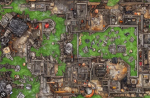
Okay but...I was out trolling for scrapyard battlemaps yesterday, and what actually is this?

1732264853611.png

I mean, initially it looks neat from a distance, but when you really look at it and start thinking about dropping a grid on it, you realize it looks like a useable map, but it very much isn't...
 
Yeah, it's no good at making dungeon maps (yet). However I bet if you added a grid and some thick black lines over the parts you deem to be walls, the players might not even notice. VTT maps always have these blurry half-details that most people assume are just "map greebles" and "texture", rather than interactable objects.
 
HEY! What did I do?


The Heretic

Oh you know, just some light heresy... a little blasphemy here, a little dissent there... typical iconoclastic stuff.

Also if you DO have six fingers - I am Inigo Montoya. You killed my father, prepare to die.
 
Okay but...I was out trolling for scrapyard battlemaps yesterday, and what actually is this?

I mean, initially it looks neat from a distance, but when you really look at it and start thinking about dropping a grid on it, you realize it looks like a useable map, but it very much isn't...
I think I could make that work in a VTT. MapTools' "Hill" VBL, and the separation of the VBL and MBL, might help with some of this. The Hill VBL/MBL is still kind of temperamental, though.
 
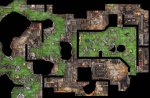
Here's how you make it work (about 15 mins of effort) - just assume anything that isn't grass is considered "difficult terrain", and you're golden:

View attachment 1428
Yeah, I would put Hill VBLs on the large black sections, and sprinkle around a lot of difficult and very difficult terrain tokens (because I can't count on all of my players to "remember" to count difficult terrain).

Hey, who around here uses VTTs a lot? I'm curious about comparing features. I've been using MapTool for a long time, but it's very DYI, and I'm wondering it the current version of other products have the features I want.
 
@Malrex, I was looking at Bryce's latest public masochism, and I was about to write that these days, "Creation Method Not Chosen By Publisher" should be a red flag that AI was involved, because I assumed that was the reason the category of "creation method" was added.

But I though that might cast the net a bit broadly, so I looked at what I think is your latest, The Coming of Winter, and saw that it said the same thing. I gather CoW was published back in April, were they asking for that category then? And if so, what options were you given? Because I would def want to answer "Made by humans with no AI assistance" to that question.

TLDR: It's unfair to say that...most publishers may not realize this box is new from DrivethruRPG and an option. MM products are all handcrafted EXCEPT for Slyth Hive to my knowledge and possibly NAP (AI Art). I'm also taking Squeen and DP off ignore.

WOW Beoric!!!...thanks for pointing this out.
I had trouble following what you were talking about, so I went into the Publisher Tools for Coming of Winter.
DrivethruRPG recently changed a bunch of stuff on their website. I don't recall them mentioning this new box to click, but I could of missed an email.

Publishers get a series of boxes to check when putting up their product for sale. There are a lot of options--from rulesets (OSR, Savage Frontiers, Traveller--there is like 16 options that are then broken down even more...Osric, OSE, Labyrinth Lord, etc.). Lot's of choices!
Then there is Product Type, Genre, Format, Languages....all broken down quite a bit more. And I think you get a limited amount of choices to choose from (10 maybe?) but seems like hundreds of options...

This is the age-old argument where customers get pissed when some publishers click everything--- OSRIC, OSE, Shadowdark, etc. to try and sell their product and get more eyes on things...(I don't do that or try not too).

ANYWAYS---yes, it looks like they added a box under Format that has Creation Method, which has 2 choices: Handcrafted and AI-Generated content. I actually just noticed that this is plastered on the publisher tools:

"AI-Generated Content
We have recently deployed two browsing options on our new DriveThruRPG marketplace and DriveThruComics PHNX Preview. Customers can now choose to filter out AI-Generated content in their Account Settings, and titles are now clearly labeled as Handcrafted or AI-Generated if the publisher has selected one of those options."


Looks like I will need to update all of the Merciless Merchants products (oh joy). All of the Merciless Merchant products use either stock art (which to my knowledge is not AI as I actually have stopped most purchases of stock art back in 2020 before AI became a big deal) or commissioned art from human artists EXCEPT for Slyth Hive by Prince and maybe NAP stuff which I don't have as much control of as its various authors (and free). The Coming of Winter is definitely hand crafted--this is the main reason we even do Kickstarters for our adventures--to commission kickass art done by humans to cover the costs.

The only time I personally have used AI for D&D is to generate NPC's real quick before I'm DMing that night because I ran out of time (and its still rough and I have to change things), never for something published.

..............................
As far as ignoring Squeen and DP, I think the timing of the election was raw and maybe things have settled down, so taking them off ignore because I value their input, discussion, and art on D&D topics and I truly don't want to bolster support for 'cancel culture', but at the same time, I don't want to discuss/support discussion of politics here. May we all roll 20's.
 
TLDR: It's unfair to say that...most publishers may not realize this box is new from DrivethruRPG and an option.

Yeah, that's what I figured when I saw it on your products.

As far as ignoring Squeen and DP, I think the timing of the election was raw and maybe things have settled down, so taking them off ignore because I value their input, discussion, and art on D&D topics and I truly don't want to bolster support for 'cancel culture', but at the same time, I don't want to discuss/support discussion of politics here. May we all roll 20's.
Fair enough, I will give it a go.
 
Hey, who around here uses VTTs a lot?

I have no choice but to play exclusively on a VTT. My group is stuck on Roll20. No one wants to learn a new interface. I think there's a lot better out there at this point.
The one thing I would add is, I hate hybridizing with Discord. If I have to have a little Discord window open over on the side, taking up valuable screen realestate, or on my phone so I can have video or chat features, that's a deal breaker.
 
Here's how you make it work

Cool. But still, all of those bits of greeble are basically nothing. The more you zoom in, the more nothing they become. This might actually help in a way since I do have players who insist on interacting with the background even when it is very obviously something I snatched off a last minute Google Image search for a random encounter...
 
Hey, who around here uses VTTs a lot? I'm curious about comparing features. I've been using MapTool for a long time, but it's very DYI, and I'm wondering it the current version of other products have the features I want.

I was a player in a 5e FantasyGrounds campaign (one of the rare few times I've not DMed). Lot's of nifty shit there, but I wasn't privy to all the stuff behind the DM screen. Also used Roll20 for a bit when the pandemic broke out... but even then, only the free version.

Cool. But still, all of those bits of greeble are basically nothing. The more you zoom in, the more nothing they become. This might actually help in a way since I do have players who insist on interacting with the background even when it is very obviously something I snatched off a last minute Google Image search for a random encounter...

Your players should probably suspend disbelief for a second and understand that, no, you don't map things to the accuracy of absolute reality. Sometimes maps are more impressionist than photorealist. "It's all just rusty, festering trash" is all I'd hope it would take to becalm their map-frazzled minds.
 
I have no choice but to play exclusively on a VTT. My group is stuck on Roll20. No one wants to learn a new interface. I think there's a lot better out there at this point.
The one thing I would add is, I hate hybridizing with Discord. If I have to have a little Discord window open over on the side, taking up valuable screen realestate, or on my phone so I can have video or chat features, that's a deal breaker.
MapTools is volunteer created and managed, and you have to program your own tokens, create your own libraries, etc. So it has a lot of flexibility, if you have the skills to do those things. Fortunately there are a lot of community members who publish shortcuts, as well as frameworks which have most of the options relevant to a particular game system. Which is good, since the last time I had any formal training in coding was a semester of Pascal in the mid-late 80s.

So the framework I use for my 4e game has a bunch of utilities. There is, for instance, a utility that allowed you to import data from (IIRC) the on-line compendium, complete with stats, powers/options, skills, etc. Nearly the whole character sheet of information. I find for monster tokens it has about 70% accuracy. As a result of this, I have more than 5000 monster tokens that are basically done, but for testing and tweaking any errors.

The tokens created with this utility have a number of macros associated with them, which appear in a window as buttons when you click a token. There are also wondows for GM marcors and global macros. So say a combat starts. I select all the tokens that are going to be in the fight, mor maybe in batches if one group has situational modifiers. I push an "add to initiative button" and a window comes up asking if I have any modifiers for the group. I add a modifier or click past that window, and the framework rolls initiative for each creature, adds the creature's intiative bonus, adds any situational bonus you entered in the window, applies the 4e rules for initiative order, and displays a list of creatures in initiative order.

So if I have a PC in that fight, when my turn comes up I attack by clicking the button for whatever power I am using. A window pops up asking who I am attacking, and I select those tokens. I enter any situational modifiers or conditions, click enter, and the framework rolls for my attack, applies ability modifiers, etc., and compares that to the monster's AC; if it is a hit, the framework rolls damage, incorporates any vulnerabilities (say, fire damage to a troll), deducts that from the monster's hit points, changes the monster's hit point bar. If the monster is dead, it changes the monster's image to a skull and moves the token to a different layer so it doesn't accidentally get clicked as the combat continues. If the monster is not dead, it applies any conditions from the attack (say, being knocked prone, or ongoing bleeding), which conditions will be tracked and applied or removed automatically as the combat continues. There are also buttons for ability checks and skill checks if you need to make those.

I can define the way creatures can see. For instance, a creature with normal vision can only see if there is a light source present. A creature with low-light vision can only see if there is a light source present, but the radius the light source illuminates is doubled (I borrowed a 3e rule for this). Things like darkvision and blindsight need no light source to see. I can also define different light sources, which can be carried by tokens or affixed to wall-mounted lamps or whatever. In addition, I can define areas of unnatural darkness, which can override light sources, or parts of light sources, and even types of light like darkvision. So for instance i could have an area where all light sources automatically drop to half their radius.

There is a vision blocking layer for defining lines of light, but there is also a movement blocking layer, and they can be applied individually. So there could be an invisible wall (you can see through it but not move your token through it) or a curtain (you can walk through it but can't see through it. In addition, there is a special vision blocking layer for elevations (you can see them from a distance) or depressions (you can see into the pit, but only if you are right next to it.

In addition to the stationary vision blocking layer, you can add vision blocking or movement blocking to a token or object. So I can make a "door" object which blocks sight and movement, and if I rotate the door to open it, the VBL/MBL moves with the object, allowing tokens to see and walk thought the doorway. Or I could have a curtain object that blocks sight but not movement. I can also make a "difficult terrain" object that requires tokens to expend more movement points when it is crossed.

I can make macros to change a token's image or size. For example, I could have a doppelganger where I click a button, and it looks like a halfling and shrinks to the size of a halfling.

In addition to the basic framework, I have incorporated some other tools that have been created by community members. For instance, there is a tool that lets you assign gear to a token, calculates encumbrance, and tells you if the creature is encumbered. And a calendar tool that lets you create your own calendar and tracks time both on a macro scale for overland travel/downtime, and on a micro scale for dungeon exploration. And it keeps track of dates for holy days, festivals, etc. There are also a bunch of tools that are availabel that I don't use - like teleporters, or switches so that players can open doors if their character is next to one (that one also allows you to just crack the door open, or look through a keyhole).

I can also assign information to objects, so a player can click on a door for a description of it (in case they weren't paying attention during the description). Plus I can add DM text to an object that only I can see, like how difficult it is to force this door or pick the lock. I usually copy paste the key for a room directly into the room's number, so I don't have to go looking for it.

All of which requires a certain amount of work, although the ability to create new macros or customize someone else's macros is nice. So how do these tools compare to the built-in features of Roll20 or Fantasy Grounds?
 
Cool. But still, all of those bits of greeble are basically nothing. The more you zoom in, the more nothing they become. This might actually help in a way since I do have players who insist on interacting with the background even when it is very obviously something I snatched off a last minute Google Image search for a random encounter...
Yeah, this is what has made me transition back to much simpler, less "realisic" maps for the most part.

Your players should probably suspend disbelief for a second and understand that, no, you don't map things to the accuracy of absolute reality. Sometimes maps are more impressionist than photorealist. "It's all just rusty, festering trash" is all I'd hope it would take to becalm their map-frazzled minds.
Players should do a lot of things they don't do.
 
So how do these tools compare to the built-in features of Roll20

It sounds a lot like the paid version of Roll20. The really expensive developer tier version where you can muck around with macros. Although admittedly a lot of that stuff you just mentioned comes built into the slightly more affordable 2nd tier. I'm not going to defend it. Roll20 is pig-easy to learn and use, and it's free, and I like the built-in video chat even if it is buggy as hell. Compared to what's available out there though, there are a lot of better options.
 
All of which requires a certain amount of work, although the ability to create new macros or customize someone else's macros is nice. So how do these tools compare to the built-in features of Roll20 or Fantasy Grounds?

I can't speak as an authority to either system. As I say, I never accessed the "guts'" of Fantasy Grounds (though my DM often gave us moments of "hang on a sec, let me program something real quick into FG..."), but it seemed quite robust on the receiving end. And I am only familiar with the free version of Roll20, which was obviously bare-bones for a reason.

In all good sense though, if you only want a feature comparison, why not just visit the official website(s)?
 
In all good sense though, if you only want a feature comparison, why not just visit the official website(s)?
I haven't for a few years, but the problem then was the marketing was pretty non-specific in its claims, and there was really no way to assess what they were actually doing without getting the product and spending a bunch of time trying to do things. And my general experience with buying digital products is they end up with limitations I didn't expect, and turn out to be not useable for my intended purpose. I have purchased many digital tools over the years, and yet the four I always end up using are all freeware (although I did purchase the upgrade for Worldographer).

Although I'm thinking of giving Dungeondraft a go, since it is dirt cheap, and it seems like it will be an easy way to make buildings, which I don't have a great tool for.
 
the problem then was the marketing was pretty non-specific in its claims,

Yeah. There's a lot of whizz bang shit going on on the home page of most of these apps and I usually end up wondering exactly how much time the DM is going to end up burning implementing this neato stuff. You're probably sitting pretty if you're happy to drop premaid maps into your game, but the second you want to use your own stuff, you're into the weeds dicking around with art or 3d software, or Unreal Engine, or laying down visibility lines in irregularly shaped caverns with tons of stalactites etc...
 
Question for you @Beoric : why not just stay with the system you're already familiar/comfortable with? I doubt you're going to find any improvements so amazing that they justify all the time and effort of switching platforms...

(Fun fact: this is the narrative I tell myself when I walk by a shelf of 5.5 books)
 
Question for you @Beoric : why not just stay with the system you're already familiar/comfortable with? I doubt you're going to find any improvements so amazing that they justify all the time and effort of switching platforms...
If something was clearly better, or the same but with less work involved, I would consider switching. If those other platforms have a steep learning curve, it wouldn't be worth it.

And in MapTools, integrating community built add-ons can be a certain amount of work. For instance, when I started using the inventory system it had some problems because the inventory system built by somebody in the community used some variables that the D&D framework built by a different person was using for a different purpose. It took me a while to chase down the problem, then figure out which application was going to be easiest to change, because like I said I'm not good at this.

(Also, why anyone building an add-on inventory system for RPGs would use "Class" as a variable for classes of items, when there is a really high chance the same variable would be used for character classes is beyond me. All of the tokens would have their character class changed to "goods", it was really annoying.)

It is also a factor for my players, who aren't very tech savvy; when we have connection problems, knowing whether it is on my end or their end is difficult, because they don't have a clue what they are doing.
 
Status
Not open for further replies.
Back
Top