General Discussion

Status
Not open for further replies.
Yes. I like the polearm section (but I think I already had it in another publication, DM Adventure Record?). I also picked out a few of the spells to sprinkle about the campaign world.

I guess I just have zero interest in new classes/races. I just don't.

EOTB plays 1e -- DUH! :)
Malrex is 2e.
 
Last edited:
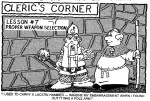
Or who knew that the Lucerne Hammer wasn't really a hammer, so clerics can't use it after all.
Pretty sure there was a comic in Dragon Magazine based on that exact point.

Yes. I like the polearm section (but I think I already had it in another publication, DM Adventure Record?).
The one in the DM Adventure Record isn't nearly as comprehensive. It might have been previously published in Dragon Magazine, most of the UA was, at least in beta form.
 
Yes. I like the polearm section (but I think I already had it in another publication, DM Adventure Record?).
The one in the DM Adventure Record isn't nearly as comprehensive. It might have been previously published in Dragon Magazine, most of the UA was, at least in beta form.
It was originally published back in Dragon #22, with different illustrations.
 
110
Prior to June 1986 I expect many players would not have known this.

Aha!

In Junior High I started collecting Dragon, in the 80-100 issue range. I'm not surprised it was issue 110 though. That issue had several articles about Roman and Norse deities, didn't it? That was a very cool issue. IIRC it might've even had a module in it.
 
I should also add that I was excited to see that John Slater used the same cover art that was used for Dragon #110 on one of his NOD modules. I forget which one. It's a cool cover, the skeleton in the woods near the unicorn.
 
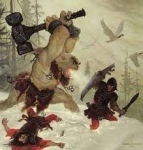
My favourite cover is Kostchtchie in the snow with snow geese flying in the bg.
1662741717712.png
That shit gets me on a variety of levels. There was this article of Kostchtchie lore I read somewhere back in the day and I haven't been able to find it since, talking about the demon lord's origins. I think it was a Dragon article. Now I'm kind of wondering if this is the same guy as the doomed knight from the Baba Yaga legend...
 
My favourite cover is Kostchtchie in the snow with snow geese flying in the bg.
View attachment 1288
That shit gets me on a variety of levels. There was this article of Kostchtchie lore I read somewhere back in the day and I haven't been able to find it since, talking about the demon lord's origins. I think it was a Dragon article. Now I'm kind of wondering if this is the same guy as the doomed knight from the Baba Yaga legend...

I'll have to check that out. Pathfinder makes him and Baba Yaha major enemies.
 
Anyway, yes, it appears the phylactery as a means of the Lich to resist a final death didn't become a thing until 2nd edition.
That's cause 2e did things right...

HA! *fans flames, ducks for cover, and continues hiking*
Only 500 miles left to go! Im naming my next character Iron Loins! And yes, I dig that cover too! Miss you all!
 
Sidebar: why do adventure writers always seem to think the Lord or the King has time to meet with a bunch of first level mercenaries adventurers? And then they write these awkward social encounters because neither the writer nor (probably) the DM or the players has any idea how that sort of conversation should go.

Most people with real status or power don't have to talk to people who don't know how to talk to them, or deal with people who don't know what they are doing. They are insulated from those frustrations by layers of underlings.

The exception to this is people whose job includes dealing with ordinary people on a regular basis, like the late Queen Elizabeth II. For her, there are a number of protocols which are carefully explained to anyone who is supposed to meet her. Those protocols aren't to insulate the monarch, BTW; they impose a structure so that the people meeting her, who otherwise wouldn't know how to handle the situation, have the comfort of knowing exactly what they are supposed to do. She was also adept at putting people back at ease if they made a mistake and were embarrassed, because like I said, the protocols aren't for her, they are to make sure everyone in the room is as comfortable as possible.

Note the reason she (and now King Charles III) has this duty is because of her role as head of state with no legislative or executive power. I would expect a king who is also a head of government (like your average D&D monarch would have fewer duties of this sort.

I think we can all agree that making up such protocols, let alone trying to enforce them on the players, is not a viable option for a D&D game, so you will always be dealing with the first type of powerful person, who doesn't have to put up with your players being idiots. If you want to talk to a king and you are a belligerent murder-hobo, you need to be high enough level that he really can't ignore you. Basically, when you are low level you can talk to an underling, when you are a knight (or equivalent) you can talk to a lord, and when you are a lord you can talk to a king.
 
Basically, when you are low level you can talk to an underling, when you are a knight (or equivalent) you can talk to a lord, and when you are a lord you can talk to a king.

Sure. Although, I feel like the general trope is that you're talking to the local lord, which in the case of a frontier territory, may actually be a hands-on kind of guy/gal since there probably isn't much of a bureaucracy at the local keep.

That said, I agree it's a drag dealing with irreverent/socially awkward players who don't want to roleplay due deference to an authority figure in the game because they're banking on your, the DM's, lack of desire to throw them in the donjon/mob them with tower guards for lèse-majesté before the adventure even gets started. Everyone thinks they're Han Solo.
...
 
Everyone thinks they're Han Solo.
Well said.

I think its an important game-element that the PCs start out as lowly nobodies that the upper classes ignore. It gives them something to strive for and real sense of (long term) accomplishment when they achieve social status. I know this cuts against the modern rrrrole-playing trope of "I am the star of a movie, watch my Big Scenes"...but for me at least, that's not quality D&D.

The process for my players in the home campaign took years of calendar time before they ever met the local king (not lord, @The1True's point is well taken). They only got an audience arraigned after they saved the daughter (abducted by goblins, in stasis in an underground lake, impregnated by an Aboleth, and missing for some 30 years) of a noble family. Even then, they got deflected to only speak to the Chancellor.

Eventually they did meet the King while impersonating his eldest son and heir (whom they had killed...for long complicated reasons). But he wasn't really the King...

For whatever reason, more than XP or gold, getting recognition/fame in the world is more desirable than anything else---but my players are young adults, it could be a life-stage thing.

Whatever the root of the desire, for that recognition to matter, it has got to be a slow build.
 
Last edited:
Slow buildup is def better. Being a "star in a movie with big scenes" is not how I view roleplaying at all and find that description a bit weird. Sounds more of elaborate backstory type player, not a roleplayer. Not to mention a DM roleplaying different NPCs all the time isnt trying to weave every performance into a big scene.
 
Sidebar: why do adventure writers always seem to think the Lord or the King has time to meet with a bunch of first level mercenaries adventurers? And then they write these awkward social encounters because neither the writer nor (probably) the DM or the players has any idea how that sort of conversation should go.
In my experience, 1st-level adventures where the PC's meet an authority figure typically have that figure be a local lord. The modern equivalent wouldn't be a meeting with the Queen of England, it would be meeting a small-town mayor or police chief.
 
Status
Not open for further replies.
Back
Top