General Discussion
- Thread starter Beoric
- Start date

Beoric
8, 8, I forget what is for
The yeoman archers were only in the 14th and 15th centuries, and were freeborn. Under Edward I they were shit conscript archers; after that they were professional contract soldiers who had to have some wealth because they were required to supply their own horses. They eventually became part of the lower gentry.Dude, English yeoman throughout the middle ages were badass motherfuckers. Poorly equipped, sure, but heavily trained as a matter of national policy. That's why they punched WELL above their weight class in the Hundred Years War.
So again, not unfree peasants, but people with the money, time and motivation to train.

The1True
8, 8, I forget what is for
Robin Hood is 12th century. The use of quarterstaff and longbow was like the Canadian hockey program (pre-institutional ickiness). Subsidized and strongly encouraged.
I will fight you on the 100 yrs war thing. I'm shitty at debate, so I'm just going to get ugly about it though. You are partially correct, in that serfs who lived and farmed directly on church or noble estates were essentially slaves, but yeomen enjoyed rights going back before the Norman conquest but were expected to train for and serve in the military when called upon. Tradesmen were not some kind of middle class nobility and did take pride in their training. They certainly were not professional soldiers though.
I will fight you on the 100 yrs war thing. I'm shitty at debate, so I'm just going to get ugly about it though. You are partially correct, in that serfs who lived and farmed directly on church or noble estates were essentially slaves, but yeomen enjoyed rights going back before the Norman conquest but were expected to train for and serve in the military when called upon. Tradesmen were not some kind of middle class nobility and did take pride in their training. They certainly were not professional soldiers though.
Beoric
8, 8, I forget what is for
According to legend, Robin Hood was an aristocrat. His merry men were outlaws and poachers.Robin Hood is 12th century. The use of quarterstaff and longbow was like the Canadian hockey program (pre-institutional ickiness). Subsidized and strongly encouraged.
I will fight you on the 100 yrs war thing. I'm shitty at debate, so I'm just going to get ugly about it though. You are partially correct, in that serfs who lived and farmed directly on church or noble estates were essentially slaves, but yeomen enjoyed rights going back before the Norman conquest but were expected to train for and serve in the military when called upon. Tradesmen were not some kind of middle class nobility and did take pride in their training. They certainly were not professional soldiers though.
The 100 years war was 14th to 15th century, which is exactly the period I am talking about above. Prior to that, yeoman (as opposed to yeoman archers) were either landowners or middle-ranking servants of an aristrocrat's household.
Last edited:
robertsconley
Should be playing D&D instead
There are two major legendary origins for Robin Hood. One where he is a yeoman from Loxley, the other that he is Earl Robert of Huntingdon. The earliest ballads paint him as a yeoman.According to legend, Robin Hood was an aristocrat. His merry men were outlaws and poachers.
Take your pick.
Beoric
8, 8, I forget what is for
That would still make him a landowner or middle-ranking servant of an aristocrat. And then an outlaw and poacher. None of that supports the argument that ordinary folks received combat training throughout their lives.There are two major legendary origins for Robin Hood. One where he is a yeoman from Loxley, the other that he is Earl Robert of Huntingdon. The earliest ballads paint him as a yeoman.
Take your pick.
robertsconley
Should be playing D&D instead
I wasn't addressing whether ordinary folks got training or not. Only your statement about the Robin Hood Legend. As for Robin Hood being a landowner the earliest ballard only state he was free which could be a lot of things. For example, he was associated with Much the Miller's son early on so he could be considered an apprentice or journeyman to a miller. The only thing consistent was he was not a villein or any other unfree status.That would still make him a landowner or middle-ranking servant of an aristocrat. And then an outlaw and poacher. None of that supports the argument that ordinary folks received combat training throughout their lives.
But the answer to that they did but the specifics ars nuanced and peasant (unfree) troops were shit in most cases. Because. their training amounted to infrequent holidays (4, 2, or 1 time a year) of drinking and eating with a little military drill on the side with the spear and other traditional militia weapons.
Feudal manorialism was big on collective responsibility. So while each serf tenant wouldn't be covered even under the lowest legal category, The serf and all his neighbors would owe the military duty of a single soldier whether they were free or unfree. The general militia existed to repel an invasion and other immediate threats. The military duty was for use by their feudal overlord for whatever purpose they saw fit although the service time was limited.
See the Anglo Saxon Fyrd, and the Assize of Arms 1181 among other things.
As time went on, most of this was converted to monetary fees with the lord hiring their troops outright. This could be a lucrative source of income for free and unfree alike. Along with the fact that the general militia was still needed for immediate threats but remained pretty much just as badly trained.
How this manifested varied a lot from region to region. Also the late serfdom of eastern Europe and Russia had it's own naunces as well.
So the general answer is yes unfree peasants got some very basic training in drill and weapons. But it was crap compared to what Knights and men at arms had for equipment and were able to accomplish with their training. But good enough that when the peasant did revolt it took a concerted effort by the king (or lords) to suppress them.
robertsconley
Should be playing D&D instead
A little more serious due to the nature of the times but basically yes.Rec sports vs. the pros?

The Heretic
Should be playing D&D instead
On a related note, monsters shouldn't necessarily have a better chance to hit you just because they have higher hit dice. This came home to in the back of the 3.0 Monster Manual II with the titanic toad.
Beoric
8, 8, I forget what is for
Yeah, that has often bugged me as well, but I suspect that's a game math/balance thing. It is probably harder to balance things if a creature's defensive abilities and offensive abilities don't scale together.On a related note, monsters shouldn't necessarily have a better chance to hit you just because they have higher hit dice. This came home to in the back of the 3.0 Monster Manual II with the titanic toad.
I have played with this idea for 4e monsters, but that was really for things that weren't meant to be a combat challenge per se. Like a really tough, heavily armored behemoth that moves slowly and can't hit the broad side of a barn (but if it hits, look out), and is meant to be treated like a force of nature. Useless as a combat challenge: it is no match for higher level parties because it can't hit them; and foolish for lower level parties to attempt since they can't hurt it, if it gets a lucky shot you are dead, and running away is so easy. So how do you even assess XP for defeating it in combat? Best to treat it as a hazard or quest instead.
Beoric
8, 8, I forget what is for
This is basically my point.So the general answer is yes unfree peasants got some very basic training in drill and weapons. But it was crap compared to what Knights and men at arms had for equipment and were able to accomplish with their training. But good enough that when the peasant did revolt it took a concerted effort by the king (or lords) to suppress them.
EDIT: Per my understanding of 3.5 rules, an 8th level expert weaver is equivalent to a 7th level fighter - that is they have the same CR. So is an 8th level commoner weaver, which makes even less sense to me since their statistics are objectively worse in every metric; just eyeballing the math, I expect he would actually be equivalent to 5th-6th level fighter. But even that seems dumb, especially since the reason he got to be such a good weaver is he spent a lot of time at it, and now he is middle aged and has spent his life sitting on his ass in front of a loom.
Also, take an 8th level expert lawyer, whose whole career has been spent sitting behind a desk, and occasionally rising to his feet to lodge some objection to the court. It is hard to see how he would equivalent to a 7th level fighter.
Now someone who is really familiar with 3.5 (I have never played it) might quibble with the CR assumptions in the rules and knock down those CRs a notch or two, but that wouldn't address the core problem. A real life experienced lawyer ought to have no chance against a real life somewhat-less-experienced soldier or cop, unless he is seriously committed to some kind of martial hobby, or at least a contact sport.
I mean, at least a 1e sage has spellcasting, and you can infer some extra hit dice and hit points from their connection to the mystical or something (although that always seemed a reach to me as well). But I feel like in general non-adventurer, non-military non-law enforcement NPCs shouldn't be much good in a fight at higher levels.
Last edited:
The1True
8, 8, I forget what is for
Mechanically, it's probably so truly weird players can take levels in Expert if they really want to without completely crippling their character (despite it being an NPC class). Probably also to dissuade players from attempting violence against high level experts. Consider it plot armour.
Beoric
8, 8, I forget what is for
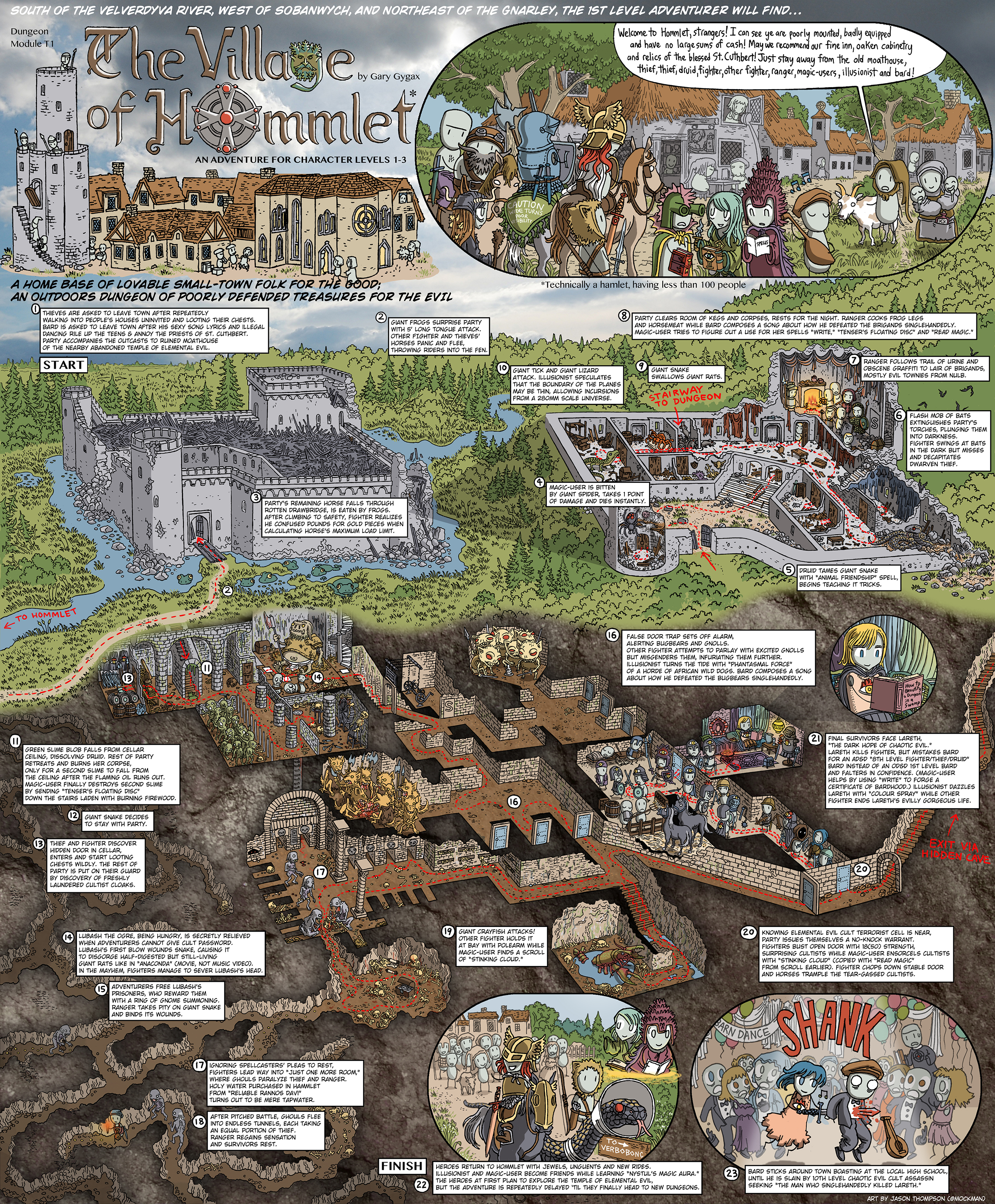
James Malieszewsi's post today reminded me of this series of cartoon maps based on classic modules, which those of you who don't keep up with WotC may have missed. I looked around and a lot of them are still online, and you can purchase prints from the author. Note there are two maps for G1, as the first ended up in a TPK.
I wanted to post the T1 walkthrough for @squeen, but it is too large, so here is the link.
I wanted to post the T1 walkthrough for @squeen, but it is too large, so here is the link.

squeen
8, 8, I forget what is for
Fun! Thank you!I wanted to post the T1 walkthrough for @squeen, but it is too large, so here is the link.
BTW you can post an image just using the link, like this:
Beoric
8, 8, I forget what is for
Welcome! I particularly enjoyed how the (player of the) MU couldn't figure out what use to make of "write", "Tenser's floating disk" and "read magic". Also where Lareth mistakes the bard for an 8th level AD&D bard instead of a 1st level OD&D bard.Fun! Thank you!
squeen
8, 8, I forget what is for
Heck yeah!Welcome! I particularly enjoyed how the (player of the) MU couldn't figure out what use to make of "write", "Tenser's floating disk" and "read magic". Also where Lareth mistakes the bard for an 8th level AD&D bard instead of a 1st level OD&D bard.

Beoric
8, 8, I forget what is for
While I'm promoting awesome products in which I have no interest, I just got a notification today that Jon Pintar put out VTT maps for Return to the ToEE. I have all his other series so far, which includes A1-4, B1, B2, GDQ, I6, S1-4, X2, and the original ToEE.
Most of these are free but I would encourage you to tip.
Most of these are free but I would encourage you to tip.